




What Is the RBI Repo Rate? Meaning, Rate Hike 2026 & EMI Impact
Every time the RBI nudges one small number, millions of Indian households feel it in their monthly budget. That number is the RBI repo rate. On October 7, 2026, the Reserve Bank of India raised it...

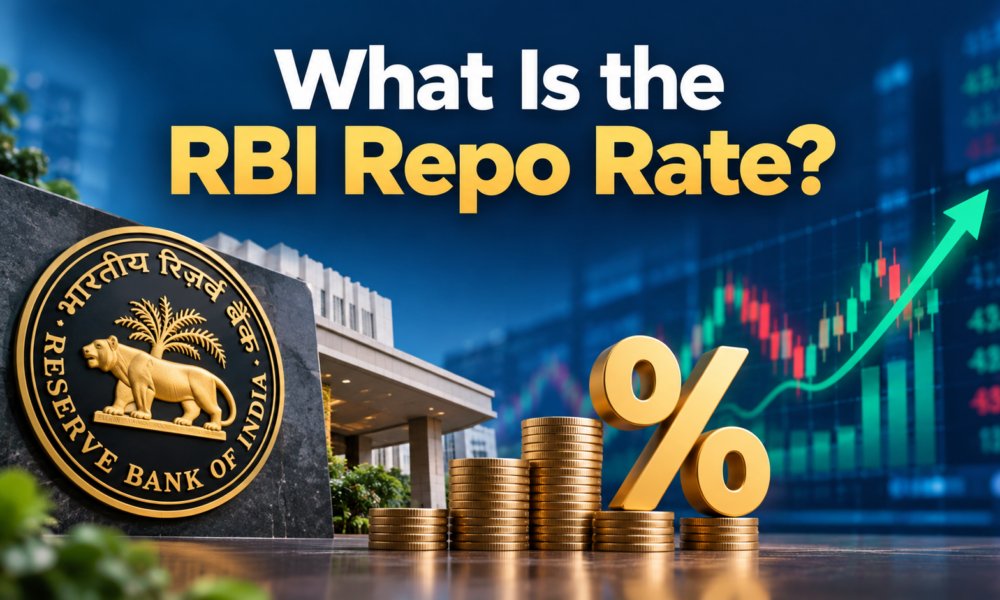
Every time the RBI nudges one small number, millions of Indian households feel it in their monthly budget. That number is the RBI repo rate. On October 7, 2026, the Reserve Bank of India raised it from 5.25% to 5.50%, its first hike since February 2023. If you have a floating-rate home loan, a fixed deposit, or a savings account, this move matters, though not always the way headlines suggest.
Table Of Content
- What Is the RBI Repo Rate?
- How Does the RBI Repo Rate Work?
- Why Does the RBI Change the Repo Rate?
- RBI Repo Rate Hike in October 2026: Latest Update
- How Does a Repo Rate Hike Affect Home Loans and EMIs?
- What Is the Impact on Fixed Deposits and Savings?
- Repo Rate vs Reverse Repo Rate
- What Does the Repo Rate Mean for the Indian Economy?
- Frequently Asked Questions About Repo Rate
- Conclusion
This guide explains what the repo rate is, how the latest hike works, and what it realistically means for your EMI, your deposits, and inflation.
What Is the RBI Repo Rate?
The RBI repo rate is the interest rate at which the central bank lends short-term money to commercial banks. Banks usually pledge government securities as collateral. The word “repo” comes from “repurchase agreement”: the bank sells securities now and agrees to buy them back later at a fixed price. The difference is the interest.
Example: A bank is short of cash for a day. It hands over government securities to the RBI, receives the money, and returns it with interest the next day to get its securities back. That interest rate is the repo rate.
How Does the RBI Repo Rate Work?
Here is the chain, step by step:
- The RBI sets the policy rate through RBI monetary policy decisions.
- Banks that need funds borrow from the RBI against government securities.
- When funding conditions change, banks may revise lending and deposit rates, each at its own pace.
- Costlier or cheaper credit shapes household spending and business investment.
- Over time, demand and inflation respond.
RBI changes the rate → Bank funding costs → Loan and deposit rates → Spending and investment → Demand and inflation
Economists call this monetary transmission. It is rarely instant, and it is never identical across banks.
Why Does the RBI Change the Repo Rate?
The RBI weighs several things before moving the rate:
- Inflation and price stability: the central bank aims to keep retail inflation near its target.
- Liquidity: how much cash is available in the banking system.
- Growth: cheaper credit can support it, costlier credit can slow it.
- Risks at home and abroad: crude oil, the rupee and global interest rates.
In general, a hike makes borrowing costlier and cools demand. A cut does the opposite. Neither guarantees a particular outcome.
RBI Repo Rate Hike in October 2026: Latest Update
The Monetary Policy Committee met from October 5 to 7, 2026. These are the reported policy figures:
| Policy indicator | Reported figure |
| Previous repo rate | 5.25% |
| Revised repo rate | 5.50% |
| Increase | 25 basis points (0.25 percentage points) |
| Standing Deposit Facility (SDF) rate | 5.25% |
| Marginal Standing Facility (MSF) rate | 5.75% |
| Bank Rate | 5.75% |
| Policy stance | Neutral changed to calibrated tightening |
| Rate decision | Unanimous |
The RBI repo rate now stands at 5.50%. Note that this is a rise of 0.25 percentage points, not a 25% increase.
Why now?
- Brent crude moved above $100 a barrel, and the rupee weakened past 96 per dollar.
- Governor Sanjay Malhotra said the inflation outlook was “no longer benign”.
Projections are a separate matter. The RBI now projects FY 2026-27 CPI inflation at 5.2%, up from 5.0%, and real GDP growth at 7.1%. These are forecasts, not actual readings, and a calibrated tightening stance does not promise another hike.
How Does a Repo Rate Hike Affect Home Loans and EMIs?
Since October 1, 2019, new floating-rate retail loans must be linked to an external benchmark, and many lenders use the repo rate. Rates on such loans are reset periodically, at least once every three months. Older MCLR-linked loans respond more slowly, and fixed-rate loans do not change during the fixed period.
So a hike does not raise every EMI overnight. The impact depends on your lender’s spread, the benchmark, your reset date, outstanding principal, and remaining tenure. At reset, the lender may raise your EMI, extend your tenure, or both.
Illustrative example (not any bank’s actual rate): assume a ₹50 lakh loan for 20 years, a lender that passes on the full 25 bps, and unchanged principal and tenure. At 8.50%, the EMI is about ₹43,391. At 8.75%, it becomes about ₹44,186, roughly ₹794 more per month.
This is why repo rate and EMI are linked, but not in a one-to-one, same-day way. Check your loan agreement for the benchmark and reset date. Home loan interest rates for new borrowers may also move at different speeds across banks.
What Is the Impact on Fixed Deposits and Savings?
Banks may raise rates on new fixed deposits, but not necessarily by the full 25 bps and not immediately. Your existing FD usually keeps its contracted rate until maturity, subject to its terms. Savings account rates are set by each bank and do not change automatically.
So borrowers and savers can feel different effects: a borrower may see costs rise, while a depositor may see better offers on fresh deposits.
Repo Rate vs Reverse Repo Rate
| Feature | Repo rate | Reverse repo rate |
| Meaning | Rate at which the RBI lends to banks | Rate at which the RBI borrows from banks |
| Direction | Banks borrow | Banks park surplus funds |
| Purpose | Meet short-term funding needs, signal policy | Absorb excess liquidity |
| Liquidity role | Adds liquidity | Removes liquidity |
Today, the RBI mainly uses the Standing Deposit Facility, rather than the reverse repo rate, to absorb surplus cash. SDF works without collateral and, at 5.25%, sets the lower end of the policy corridor, while MSF at 5.75% sets the upper end.
What Does the Repo Rate Mean for the Indian Economy?
Investors should also understand portfolio diversification when assessing how changing interest rates may affect different investments.
- Inflation and demand: costlier credit can cool consumer spending, though prices respond slowly.
- Business investment: higher borrowing costs may delay expansion plans.
- Housing and vehicles: loan-linked purchases can become less attractive.
- Banks: lending and deposit rates may adjust at different speeds.
- Growth: the RBI tries to balance price stability against economic growth.
Frequently Asked Questions About Repo Rate
What is the current repo rate in India?
The current RBI repo rate is 5.50%, after the RBI raised it by 25 basis points on October 7, 2026. The next policy meeting is scheduled for December 2 to 4, 2026.
How does a repo rate hike affect home loan EMI?
Home loan interest rates linked to the repo rate may rise at the next reset. Your lender may raise the EMI, extend the tenure, or both. Fixed-rate loans stay unchanged during the fixed period.
Does a repo rate hike increase fixed deposit rates?
Banks may raise rates on new deposits over time, but not automatically or equally. Existing deposits generally keep their contracted rate until maturity.
Who decides the repo rate in India?
The six-member Monetary Policy Committee, chaired by the RBI Governor, decides it by vote. It includes three RBI representatives and three external members appointed by the Government.
Conclusion
The RBI repo rate is the main lever of RBI monetary policy, used to balance inflation and growth. Yet the link between the repo rate and EMI, or between the policy rate and your deposit income, depends on your product and your lender.
Check whether your loan is repo-linked, note your reset date, and compare new FD rates before locking in. One 0.25 percentage point move is a signal, not a verdict.