




• contact@stockmarketsimplified.com
stockmarketsimplified stockmarketsimplified
  • Home
  • Glossary
  • Contact
Search the Site
Popular Searches:
iPhone Artificial Intelligence Smartphones
Recent Posts
What Is a Shooting Star Candlestick?
October 13, 2026
Trading scams
Trading Scams: Fake Trading Courses and Guaranteed-Return Schemes
October 12, 2026
Gold ETFs in India
Gold ETFs in India: 10 Things to Know Before Buying
October 11, 2026
stockmarketsimplified stockmarketsimplified
  • Home
  • Glossary
  • Contact
Popular News
Common Mistakes in Intraday Trading
10 Common Mistakes in Intraday Trading and How to Avoid Them
October 9, 2026
Golden Crossover
What Is a Golden Crossover?
October 8, 2026
What is the Strike price
What Is the Strike Price?
October 7, 2026
Follow Us
Subscribe
Home/Glossary/What Is Portfolio Diversification?
Glossary

What Is Portfolio Diversification?

Curious about portfolio diversification? That means you are thinking like a clever investor. In simple terms, it means spreading your money across various investments. Don’t put everything into one...

Suhani
Suhani
September 23, 2026 3 Min Read
183 0
Portfolio Diversification

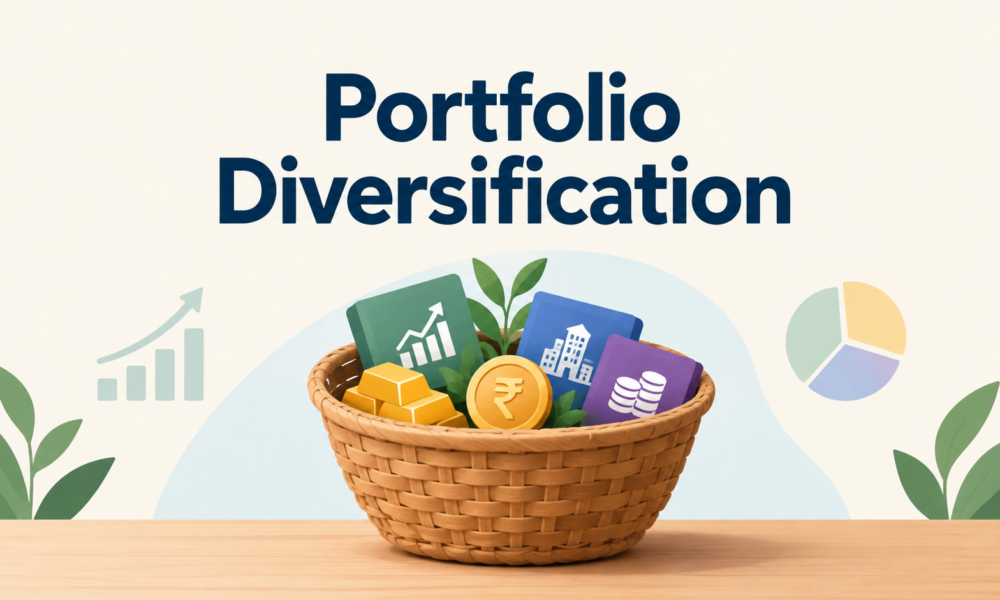
Curious about portfolio diversification? That means you are thinking like a clever investor. In simple terms, it means spreading your money across various investments. Don’t put everything into one stock or sector.

Table Of Content

  • Understanding Portfolio Diversification
  • Why Portfolio Diversification Matters
  • Key Benefits of Diversifying Your Portfolio
  • How to Build a Diversified Investment Portfolio
  • Common Mistakes to Avoid in Portfolio Diversification

Curiosity about portfolio diversification is a good starting point for building a balanced investment plan. 

Understanding Portfolio Diversification

Portfolio diversification means investing in various asset classes, sectors, and instruments. This way, your financial health won’t rely on one outcome. Think of it as not putting all your eggs in one basket.

Say you invest only in IT stocks. If the sector faces a slowdown, your entire portfolio takes a hit. But if you also hold banking stocks, gold, and a few mutual funds, one bad sector won’t sink your whole plan.

That’s diversification in investing at its core. 

This approach shows how diversification in investing can work across different asset classes.  They could invest in fixed deposits, gold, and US stocks. They can use international platforms for this. Each asset behaves differently under different market conditions.

Why Portfolio Diversification Matters

Markets are unpredictable. One month IT stocks rally, the next month it’s banking or pharma. No one can reliably predict which sector will do best. This is one of the main reasons diversification in investing matters for long-term investors. 

This is why portfolio diversification can be useful when market conditions change. 

But what if one stock crashes? If you invest a lot in one company and it fails, your savings might drop quickly. A diverse portfolio helps soften losses. Your various investments typically don’t decline at the same time or for the same reasons.

This is the heart of investment diversification strategy in investing. You’re not trying to avoid losses altogether, since that’s impossible. You’re trying to make sure no single loss can wipe you out.

For more information on investment risks and diversification, investors can refer to the investor-education resources provided by SEBI.

Key Benefits of Diversifying Your Portfolio

  • Portfolio diversification most obviously benefits by reducing risk. Spreading your money across sectors helps balance downturns. Consider FMCG, banking, tech, and pharma. This strategy can protect your investments. If one area drops, another can stay stable.
  • This makes risk management in investing an important part of building a balanced portfolio. 
  • It also smooths out your returns over time. A diversified portfolio grows steadily instead of swinging wildly. This steadiness is easier on your nerves during volatile times.
  • Diversification also opens doors to opportunities you might otherwise miss. Adding gold or international stocks to Indian shares helps you follow global trends.
  • Portfolio diversification reduces risk by spreading investments. Different assets usually don’t fall together. So, when one investment loses value, gains or stability in another can help balance it out.

How to Build a Diversified Investment Portfolio

A solid investment diversification strategy starts with asset allocation and diversification working together. Choose how much of your money to invest in equity, debt, gold, and cash. Base this on your age, goals, and how much risk you can handle.

Proper asset allocation is also an important part of risk management in investing. 

In equities, don’t buy five IT stocks. Instead, include different sectors like banking, consumer goods, healthcare, and manufacturing. Mutual funds and index funds make this easier since they already hold a basket of stocks.

If you want to diversify your investment portfolio easily, begin with small steps.

A simple investment diversification strategy can make this process easier for beginners. 

  • A Nifty Index Fund
  • A debt fund
  • Some gold via Sovereign Gold Bonds or ETFs
  • A small allocation to global stocks

This type of investment diversification strategy keeps the portfolio simple while spreading exposure. 

Common Mistakes to Avoid in Portfolio Diversification

  • Many new investors think owning ten mutual funds means they’re diversified. If those funds hold large-cap stocks, you’re adding more of the same. 
  • Another mistake is ignoring debt and gold while chasing only high-return equity options. A good diversified stock portfolio India strategy leaves room for safer instruments, too.
  • Over-diversifying is also a trap. Having too many assets can make it hard to track your portfolio. It might also dilute your returns without meaningfully lowering your risk.
  • Good risk management in investing is about finding the right balance rather than simply adding more assets. 
  • Finally, many people forget to revisit their allocation. What is portfolio diversification, and why is it important if you never rebalance? Markets shift, and your portfolio should shift with them at least once a year.
  • A practical investment diversification strategy should also be easy to maintain over time. 

Share Article

Suhani

Suhani Content Writer

Suhani is a skilled finance content writer dedicated to creating insightful, engaging, and reader-focused content. With a deep understanding of personal finance, investments, market trends, and financial planning, Suhani excels at turning complex financial topics into simple, actionable insights. From demystifying tax strategies to exploring smart investment options, Suhani provides readers with the knowledge they need to achieve financial success. Known for a professional yet approachable writing style, Suhani blends research, clarity, and creativity to craft content that resonates with diverse audiences. Trusted by clients and readers alike, Suhani is your go-to expert for finance content.

What is hedging in the stock market
Previous Post

What Is Hedging in the Stock Market? 

What Is a Doji Candlestick? A Doji candlestick appears like a plus sign or a cross on stock charts. If you've seen one, that's what it is. In simple terms, a Doji candlestick forms when the open and close prices of a stock are almost the same. It shows a tug-of-war between buyers and sellers, where neither side wins clearly. The Doji is a key candlestick pattern for beginners to learn. Doji Candlestick Meaning The word "Doji" comes from Japanese, and it roughly means "mistake" or "the same." That's fitting because a Doji candle shows a moment when the market couldn't decide which way to go. Think of it as a rope-pulling contest. Buyers pull one way, while sellers pull the other. By the end of the session, both sides are nearly back where they began. That's the core Doji pattern meaning for beginners. How a Doji Candle Forms (Open and Close Prices) Every candlestick has four price points: open, high, low, and close. In a normal candle, the open and close prices differ quite a bit, which gives the candle a thick body. In a Doji candlestick, the open and close prices are nearly equal. This forms a thin or nearly invisible body. Wicks, or shadows, extend above and below. Those wicks show how much the price moved during the session. Then, it returned close to the opening level. Main Types of Doji Patterns Not all Doji candles look the same. Here are the main types every trader should recognize: Standard/Neutral Doji: Small wicks on both sides, showing balanced indecision Long-Legged Doji: This candle has long wicks on both sides. It shows that the price moved a lot but closed close to the open. This shows strong trading indecision Dragonfly Doji: Looks like a "T". The long lower wick shows sellers pushed the price down, but buyers pulled it back up by close. Often seen near the bottom of a downtrend Gravestone Doji: Looks like an upside-down "T". A long upper wick shows buyers pushed the price up, but sellers dragged it back down. Often seen near the top of an uptrend What Does a Doji Tell Traders? (Indecision & Reversal Signals) A Doji pattern mainly signals one thing: uncertainty. Neither buyers nor sellers have full control during that session. A Doji after a strong trend is important. It can signal a possible reversal pattern. This means the current trend may be losing power and could change direction. A Dragonfly Doji that appears after a downtrend can signal a bullish reversal. In contrast, a Gravestone Doji after an uptrend may signal a bearish trend. But here's the honest part: a single Doji candle doesn't confirm anything on its own. It's a warning sign, not a certainty. How to Use Doji Candlestick in Trading (With Caution) To read Doji candlestick patterns well, don't rely on the candles; always use other tools too. Check the trend before and after the doji Look at support and resistance levels nearby Confirm with volume since a Doji on high volume carries more weight Wait for the next candle to confirm the direction It is like reading one line of a book. You can get hints, but not the full story. Doji Candlestick in the Indian Stock Market Context Doji candles frequently appear for Indian traders on the NSE and BSE. This is especially true during results season or major news events. These times bring more uncertainty to the market. Many beginners in the Indian stock market feel excited when they spot a Doji candlestick. They often expect an immediate reversal. That's a common mistake. Experienced traders treat it as one piece of the puzzle, not the whole picture. If you're new, start by finding Doji patterns on index charts like Nifty or Bank Nifty. Watch what happens after they form, and note how price reacts near key levels. Over time, this pattern recognition becomes second nature. A Doji candlestick is important for beginners. It boosts confidence in reading price charts. This knowledge can lead to better trading decisions.
Next Post

What Is a Doji Candlestick?

Top Authors
Suhani
SuhaniContent Writer
114 Posts
Manaswi Agarwal
Manaswi AgarwalContent Writer (Finance, Stock market)
50 Posts
Top Categories
Stockmarket Simplified Stockmarket Simplified
50 Posts
Glossary Glossary
66 Posts
Most Viewed
Common Mistakes in Intraday Trading
10 Common Mistakes in Intraday Trading and How to Avoid Them
October 9, 2026
Golden Crossover
What Is a Golden Crossover?
October 8, 2026
What is the Strike price
What Is the Strike Price?
October 7, 2026

Related Posts

What Is a Shooting Star Candlestick?
Glossary
What Is a Shooting Star Candlestick?
Suhani
By Suhani
Double Top Pattern
Glossary
What Is a Double Top Pattern?
Suhani
By Suhani
Golden Crossover
Glossary
What Is a Golden Crossover?
Suhani
By Suhani
What is the Strike price
Glossary
What Is the Strike Price?
Suhani
By Suhani
instagram image
instagram image
instagram image
instagram image
instagram image
instagram image
Instagram
stockmarketsimplified stockmarketsimplified
  • contact@stockmarketsimplified.com
Helpful Links
  • Glossary
  • Contact
  • Privacy Policy
  • Terms And Conditions
Popular Posts
What Is a Shooting Star Candlestick?
Suhani
October 13, 2026
Trading Scams: Fake Trading Courses and Guaranteed-Return Schemes
Suhani
October 12, 2026
Gold ETFs in India: 10 Things to Know Before Buying
Suhani
October 11, 2026
Follow Us
Facebook
Twitter
Youtube
Instagram
Stay Informed
©Copyright 2026. stockmarketsimplified.com. All Rights Reserved