




What Is a Benchmark Index?
Think your portfolio grew 11% last year. Is that good? It depends on what the wider market did. So, what is a benchmark index, and why do investors keep mentioning it? In short, it is a reference...

Think your portfolio grew 11% last year. Is that good? It depends on what the wider market did. So, what is a benchmark index, and why do investors keep mentioning it? In short, it is a reference point showing how a market or segment performed, so you can judge your own results fairly.
Table Of Content
This guide covers the benchmark index meaning, how it works, and how to use one.
What Is a Benchmark Index?
The benchmark index meaning is simple. It is a basket of securities, such as stocks or bonds, tracked together and summarized in a single number. That number rises and falls with the value of the underlying holdings.
Think of a class average. A score of 70 means little until you learn the class averaged 55. In the same way, a return only makes sense next to the return of a relevant stock market benchmark.
One point matters here. An index is a measurement, not a product. You cannot buy the index itself, though you can buy an index fund or an exchange-traded fund (ETF) that aims to copy it.
How Does a Benchmark Index Work?
Each market index follows a defined set of companies, chosen by rules such as size, trading activity, or sector. The provider weighs those companies, usually by market capitalization (the total value of a company’s shares), and recalculates the level throughout the trading day. A market index is reviewed on a schedule, so companies can enter or leave.
Index performance is usually quoted as a percentage change over a day, a year, or longer. Once you know it, you have a baseline. Your investment beat the index performance, trailed it, or matched it. That gap tells you more than a raw percentage ever could, and it is the practical answer to what is a benchmark index in daily use.
Why Is a Benchmark Index Important?
Investors, fund managers, and analysts all lean on benchmark returns for the same reason: context. A fund that returned 9% looks decent until the market delivered 14%. Checking benchmark returns also keeps marketing claims honest.
Benchmarks help in a few practical ways:
- They show whether a fund manager added value beyond the market.
- They reveal whether portfolio performance came from skill or simply a rising market.
- They keep expectations realistic in rough years, when even strong portfolios fall.
A good investment benchmark promises nothing. It only describes what the market did, which is exactly why it is useful.
Examples of Benchmark Indexes
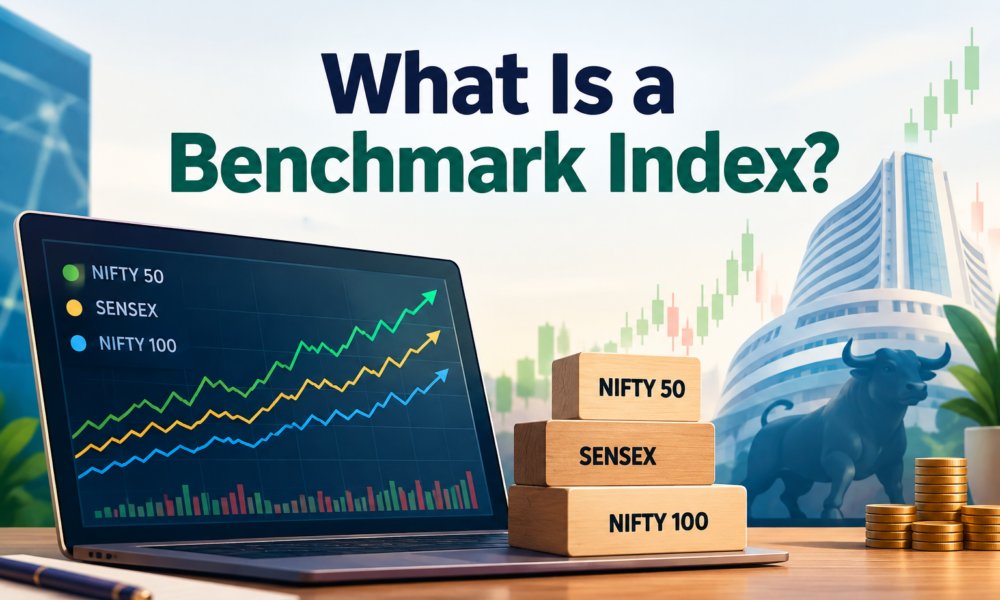
Nifty 50 tracks 50 large companies listed on the National Stock Exchange of India. It is widely used to judge Indian large-cap funds.
For official information about the index’s composition and methodology, visit the Nifty Indices official website.
Sensex follows 30 well-established companies on the BSE, formerly the Bombay Stock Exchange. It is among the oldest and most quoted gauges of the Indian market.
S&P 500 covers 500 large U.S. companies and is the common stock market benchmark for American equity funds.
Bond funds, mid-cap funds, and sector funds have their own indexes, so the right choice depends on what you hold.
How to Compare Your Investment With a Benchmark
Start by picking a benchmark that matches your investment. An Indian large-cap fund belongs next to the Nifty 50 or Sensex, not the S&P 500. Knowing what is a benchmark index only helps if you choose the right one.
Then follow a few steps:
- Use the same time period for both.
- Calculate your return and the benchmark return over that period.
- Check whether the index figure includes dividends. A total return index does; a price index does not.
- Subtract one from the other.
If you trail the benchmark, look at fees and risk before drawing conclusions. Choosing an investment benchmark carelessly can paint a misleading picture. Reviewing portfolio performance once or twice a year is usually enough. Short periods can mislead, so longer comparisons are fairer, and none of them predicts what comes next.
Key Takeaway
What is a benchmark index? It is a measuring stick for a market or segment, built from a defined group of securities. It cannot be bought directly, but it gives your returns the context they need. Used carefully, it turns a number like 11% into something you can judge.