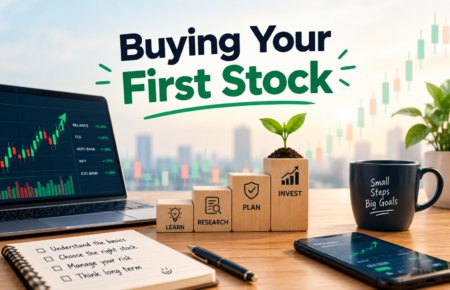





7 Things to Know Before Buying Your First Stock
You open a brokerage app for the first time. There are thousands of tickers, a handful of company names you recognize, and a green “Buy” button that feels oddly final. Which one do you...


You open a brokerage app for the first time. There are thousands of tickers, a handful of company names you recognize, and a green “Buy” button that feels oddly final. Which one do you pick?
Table Of Content
Buying your first stock has never been easier, but the real work happens before you tap that button. Here are seven things to know before buying your first stock, so you understand what you own, how much risk you are taking, and why you chose it.
What to Know Before Buying Your First Stock
1. Understand the Company You Are Buying
A share of stock is a small slice of ownership in a company. So the first question is simple: how does this company make money? That is its business model.
Next, look at what it sells, who buys it, which industry it competes in, and who its main competitors are. If you cannot explain the business in two or three sentences, keep researching.
Liking a product is only a starting point. A company can make something you love and still struggle financially. Two terms help here:
- Revenue is the money coming in from sales.
- Profits are what remains after costs. Profitability is whether the company can do that consistently.
If you are wondering how to choose your first stock, start with businesses you can understand and whose long-term prospects you can reasonably judge. It is also the best answer to what to consider before buying a stock.
2. Check the Stock’s Financial Health
You do not need to become a professional analyst. Basic fundamental analysis means reading a company’s financial statements: the income statement, the balance sheet, and the cash flow statement. Most companies publish them, and many brokerage apps summarize them.
You can also review a company’s official filings through SEC investor resources to better understand its financial information and disclosures.
Keep a short list of questions:
- Is the company generating revenue, and is it growing or shrinking?
- Is it profitable, or is it still losing money?
- How much debt does it carry compared with what it earns?
- Is it producing healthy cash flow, meaning real cash moving in and out?
- What do its recent earnings reports show?
Earnings are a company’s profit over a set period, usually reported every quarter. One weak quarter is not a verdict. A steady pattern is more informative.
3. Look at Valuation, Not Just the Stock Price
A low stock price does not mean a bargain, and a high one does not mean it is overpriced. The share price alone tells you very little.
Here is a hypothetical example. Company A trades at $20 a share and has 5 billion shares outstanding. Company B trades at $100 a share and has 100 million shares. Company A’s market capitalization (share price multiplied by total shares) is $100 billion. Company B’s is $10 billion. The “cheaper” stock is the far larger company.
Valuation asks whether the price makes sense relative to the business, often by comparing it with earnings. If a company pays a dividend, which is a cash payment to shareholders, check the dividend yield: the annual dividend divided by the share price. A very high yield can be a warning sign rather than a gift, because it sometimes means the market doubts the payout will last.
4. Know Your Risk Tolerance and Diversification
Risk tolerance is how much ups and downs you can handle without losing sleep or making rash choices. Your investment goals and time horizon shape it.
So, should beginners buy individual stocks? There is no universal answer, only trade-offs. Individual stocks let you pick companies you believe in, but they carry company-specific risk. If one business stumbles, your portfolio feels it.
Funds spread that risk:
- An index fund tracks a market index, such as a large group of well-known companies.
- An ETF (exchange-traded fund) holds many investments and trades like a stock.
- A mutual fund pools money from many investors and is typically priced once a day.
This is diversification: spreading money across many holdings so no single one decides your outcome. Many people, including anyone buying stocks for the first time, blend funds with a small number of individual stocks. Buying your first stock does not require you to choose one approach forever.
5. Don’t Invest Money You May Need Soon
Stock prices move, sometimes sharply. That market volatility is normal, but it is a problem if you need the money next month for rent, tuition, or an emergency.
Match each dollar to a purpose. Money for the next year or two usually belongs somewhere steadier. Money you will not touch for many years can tolerate more investment risk, because there is time to recover from downturns.
This is where long-term investing earns its reputation. Time gives compound growth a chance to work, meaning your gains can generate their own gains. It is not guaranteed, and values can fall as well as rise. An honest investment plan starts with asking when you will need the money.
6. Have a Plan Before the Market Moves
Prices will jump and drop after you buy. Without a plan, it is easy to slip into emotional investing, buying out of excitement or selling out of fear.
Before buying your first stock, write down three answers in an investing journal:
- Why am I buying this?
- What do I expect from the company?
- What would make me reconsider?
This gives you something to check against when headlines get loud. It also builds your investing strategy one decision at a time.
If you are unsure how to research a stock before buying, combine the steps above: understand the business, read the financial statements, check the valuation, then record your reasoning. Good stock research is a habit, not a one-time task. Among the most useful stock investing tips is this one: judge the decision by your reasoning, not by next week’s price.
7. Know How You Will Invest Over Time
One stock is a purchase. An investing strategy is a plan for the next several years.
Dollar-cost averaging means investing a fixed amount at regular intervals, no matter what the market is doing. You buy more shares when prices are low and fewer when they are high. It does not guarantee profit, but it removes the pressure of timing the market perfectly, and your portfolio builds gradually.
If real money feels scary, try paper trading. A stock market simulator lets you practice with pretend money, so you can learn how orders work and how it feels to watch prices swing. Practice cannot replicate the emotions of risking your own cash, but it is a gentle start to beginner investing.
Quick Recap
| Before Buying | What to Check |
| Company | Business model and industry |
| Financial health | Revenue, earnings and profitability |
| Valuation | Price relative to business fundamentals |
| Risk | Risk tolerance and time horizon |
| Diversification | Individual stocks vs. broader funds |
| Strategy | Why you are buying and your investment plan |
First Stock Buying Checklist
□ I understand what the company does.
□ I have researched its financial health.
□ I understand why I am considering the stock.
□ I have considered valuation.
□ I understand the investment risk.
□ I know my time horizon.
□ I am not relying on short-term price predictions.
□ I understand whether the stock fits into my portfolio.
□ I have an investment plan.
FAQs
What should I know before buying stocks?
Know the company, its financial health, its valuation, your risk tolerance, and your time horizon. Then write down why you are buying.
How do I buy my first stock?
Open a brokerage account, which is a type of investment account, and add money. Then place an order for the stock. Remember that cash sitting in the account is not invested until you buy something.
What makes a good stock investment?
There is no guarantee, but a good stock investment usually involves an understandable business, sound financials, a reasonable valuation, and a fit with your goals.
How do I start investing in stocks as a beginner?
Learn the investing basics, set clear goals, consider funds as well as individual stocks, and begin with an amount you can afford to leave invested.
Conclusion
Buying your first stock does not mean finding the perfect company. It means understanding what you are buying, why you are buying it, what risks come with it, and how it fits into your broader plan. Take your time, start small, and keep learning. Stock investing for beginners is a skill built over years, not one purchase.