




What Is a Dead Cat Bounce?
What is a dead cat bounce, really? It is a brief, temporary price recovery that shows up in the middle of a larger decline. The dead cat bounce meaning comes from a blunt Wall Street joke: even a...

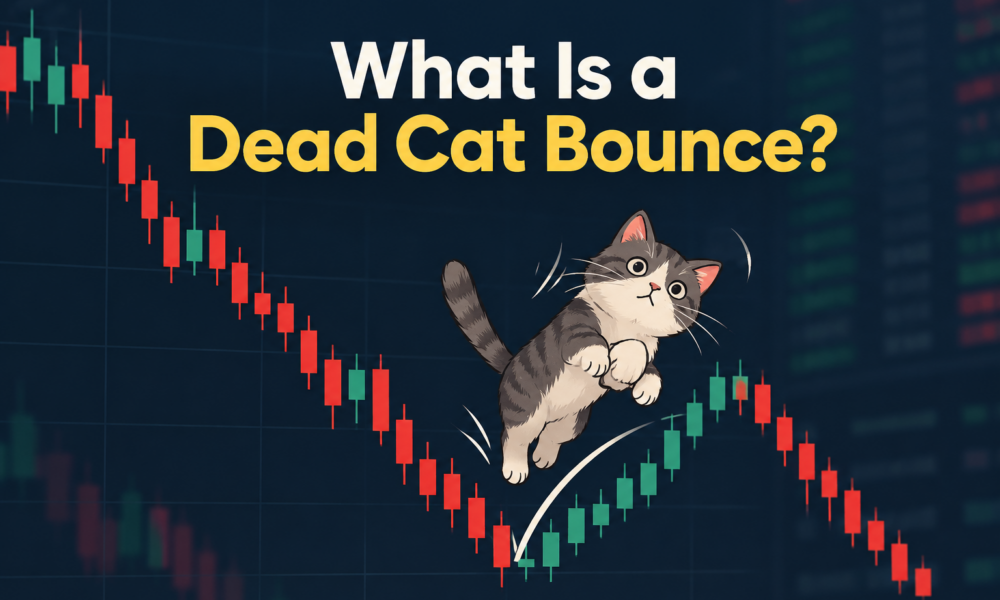
What is a dead cat bounce, really? It is a brief, temporary price recovery that shows up in the middle of a larger decline. The dead cat bounce meaning comes from a blunt Wall Street joke: even a dead cat will bounce if it falls from high enough. The bounce says nothing about whether the cat is still alive.
Table Of Content
In stocks, the term describes a small rally after a sharp fall, followed by another leg down. Dead cat bounce in stocks is a label people usually apply afterward, because nobody can be sure in real time whether a rebound will hold. Prices often bounce simply because a fast drop overshoots. Bargain hunters step in, and traders who bet against the stock close positions to lock in gains. That buying lifts the price for a few sessions.
How Does a Dead Cat Bounce Happen?
It usually starts with bad news, such as a weak earnings report or a broader stock market decline. Sellers rush out, trading volume spikes, and the price falls quickly. Then the selling runs out of steam for a moment. Buyers who think the stock is now cheap start nibbling, and the price climbs.
Sentiment does the rest. Investors who missed the drop hope for a stock price rebound, and some read the uptick as a sign the worst has passed. But the reasons that triggered the fall often remain unresolved. Once the short-term buyers are done, sellers return, and the bearish trend picks up where it left off.
That is why the bounce fails to become a real turning point. It is driven by mechanics and hope, not by a change in the company’s outlook.
Dead Cat Bounce Example
Picture a stock trading at $100 today. After a disappointing earnings report, it drops to $70 in a week. Over the next three days it recovers to $78, a gain of roughly 11 percent. Headlines call it a strong comeback.
Then more bad news arrives and the stock slides to $62. Anyone who bought at $78 hoping for a market recovery is now sitting on a loss. Looking back, the climb from $70 to $78 was a dead cat bounce. This dead cat bounce example is simple, but real charts are rarely this tidy. Ask what is a dead cat bounce vs reversal here, and the answer is only clear once the price keeps falling.
Dead Cat Bounce vs. a Genuine Reversal
Telling a dead cat bounce vs reversal apart is the hard part, and no signal works every time. Still, analysts look at a few clues as part of technical analysis.
- Trading volume: a rebound on thin volume suggests weak conviction, while a rally on heavy volume may show real buying interest.
- Support and resistance: if the price stalls at a former support level that now acts as resistance, the rebound may be running out of room.
- Price action: a genuine reversal tends to form higher lows and higher highs over time, not a single sharp pop.
- Market conditions: a recovering broader market makes a lasting turnaround more plausible than a falling one.
None of these guarantees an outcome. So what is a dead cat bounce versus a healthy recovery? Often, only the weeks that follow can answer that.
Why Does a Dead Cat Bounce Matter to Investors?
Knowing the dead cat bounce meaning helps people read market movements with more caution. A sudden jump after a stock market decline can feel like proof that the trouble is over, and that feeling has led many people to misjudge the situation. Understanding that a temporary price recovery can happen inside a downtrend encourages patience and a closer look at the fundamentals behind the move.
What is a dead cat bounce not, though? Not every rally after a fall is fake, and labeling every bounce as a dead cat can cause someone to overlook a genuine recovery. The term is best treated as a useful lens for discussion, not a forecast. Spotting a dead cat bounce in stocks is really about understanding how markets sometimes behave, since nobody can say what a particular stock will do next.
Understanding a temporary rebound is also part of managing investment risk. Investors can learn more about how stock prices fluctuate and the risks involved in investing throug Investor.gov’s stock and investing resources.