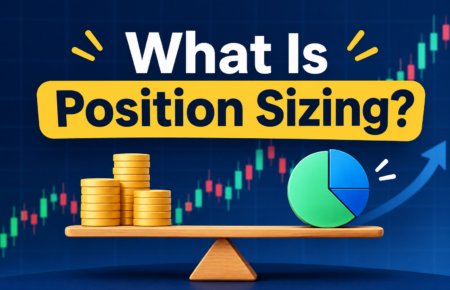





What Is Position Sizing?
Every trader, new or experienced, faces the same question before placing an order: how much should I buy? Position sizing answers that question. It decides how many shares or lots you take in a trade...


Every trader, new or experienced, faces the same question before placing an order: how much should I buy? Position sizing answers that question. It decides how many shares or lots you take in a trade so that one bad call does not damage your account.
Table Of Content
In the stock market, you cannot control whether a trade will win or lose. You can only control how much you risk on it. That is why position sizing in the stock market matters so much, especially for beginners.
What Is Position Sizing in Trading?
Position sizing in trading is the process of deciding how much money to put into a single trade. The answer is usually shown as the number of shares, or the lot size in case of futures and options.
It is not the same as stop-loss. A stop-loss tells you where you will exit if the trade goes wrong. Position size in trading tells you how many shares you hold when that exit happens. The two work together.
It is also different from capital allocation. Capital allocation is about how you divide your money across stocks, sectors or strategies. It looks at one trade and asks how much of your trading capital is at risk in it.
How Does Position Sizing Work?
How does it work in trading? You start by deciding how much of your capital you are willing to lose on one trade. This is your risk per trade. Many traders keep it between 1% and 2% of their capital, though the right number depends on the person.
For a better understanding of how trade size, stop-loss levels and risk limits work together, refer to CME Group’s guide on proper position sizing.
Next, you pick your entry price and your stop-loss price. The gap between them is the risk on each share. Finally, you divide your total risk amount by the risk per share. The result is the number of shares to buy.
How to Calculate Position Size in the Stock Market?
Here is a simple example with an Indian stock.
- Trading capital: ₹2,00,000
- Risk per trade: 1%, which is ₹2,000
- Entry price: ₹500
- Stop-loss price: ₹480
- Risk per share: ₹500 minus ₹480, which is ₹20
- Position size: ₹2,000 divided by ₹20, which is 100 shares
So you can buy 100 shares. If the stop-loss hits, you lose ₹2,000, which is exactly 1% of your capital. The total value of the trade is ₹50,000, which is well within your capital.
Position Size for Futures and Options
For F&O, divide your risk amount by the risk per lot. If one lot has 25 units and your stop-loss is ₹10 away, the risk per lot is ₹250. With ₹2,000 of risk, you can trade 8 lots.
Why Is Position Sizing Important?
Why is it important in trading? Because it protects you from large losses. Even a good trader faces a string of losing trades. If each loss is small, your account survives and you get to trade another day.
Position sizing also removes guesswork and emotion. You know your maximum loss before you enter, so you are less likely to panic or hold on to a falling stock. It is a core part of risk management and keeps trading risk under control.
Factors to Consider When Deciding Position Size
There is no single right size for everyone. A good position sizing strategy considers a few things:
- Trading capital: smaller accounts need smaller positions.
- Risk tolerance: how much loss you can handle.
- Stop-loss distance: a wider stop-loss means fewer shares.
- Volatility: jumpy stocks need smaller positions.
- Trading style: intraday and swing trades may need different risk limits.
Common Position Sizing Mistakes
Beginners often make these errors:
- Putting too much capital in one stock because of a strong tip.
- Using the same quantity for every trade, ignoring the stop-loss distance.
- Increasing size after a loss to recover quickly.
- Risking more than they can afford to lose.
Final Thoughts
Position sizing will not make every trade a winner, but it keeps your losses small enough to keep trading. Start with low risk per trade, calculate your quantity before every order, and review your results. This article is for education only and is not investment advice.