


What is Emotional Trading?
Emotional trading happens when your gut jumps in before your brain has even looked at the chart. You are reacting, not deciding. Researchers who study this call it trading psychology or behavioural...

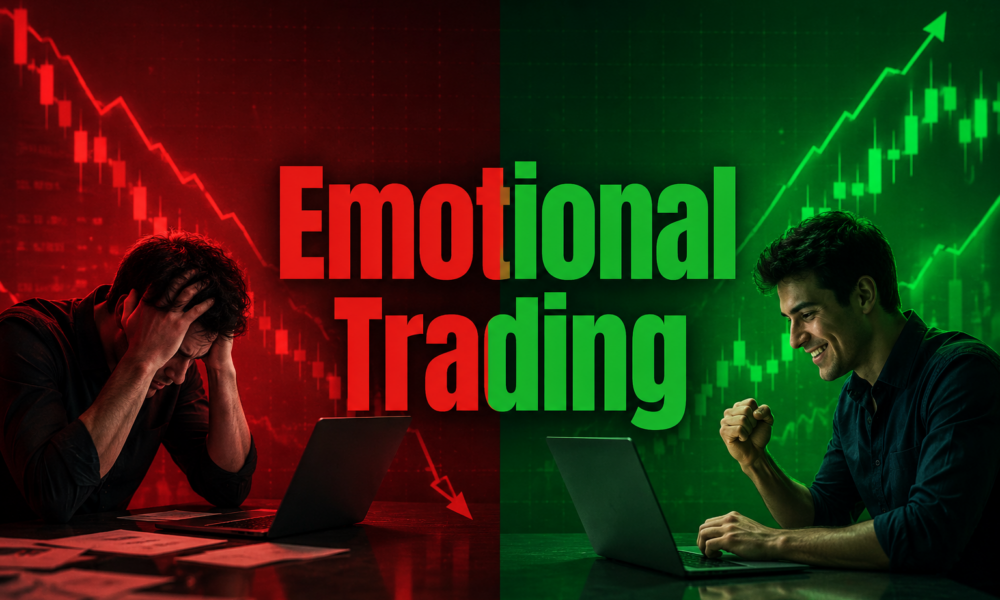
Emotional trading happens when your gut jumps in before your brain has even looked at the chart. You are reacting, not deciding. Researchers who study this call it trading psychology or behavioural finance- basically, the science of why humans make bad money decisions when emotions get involved.
Fear and greed are the usual suspects. Fear makes you bail out of a position way too early, or skip a trade that was actually solid. Greed does the opposite; it keeps you holding on past the point where you should have booked profits, because “it might go up a bit more.”
FOMO is another one. You see a stock running up, everyone is talking about it on Twitter or in your trading group, and you buy in without checking anything, just because you do not want to miss the ride. Revenge trading is uglier still: you lose money on one trade, get frustrated, and immediately throw in a bigger, riskier bet trying to win it back. It rarely works.
A good example of this plays out in Indian markets fairly often. Nifty drops 3% in a day due to news out of the US, and a trader who bought shares last week panics and sells at a loss, only for the index to recover within 48 hours. That is panic selling, plain and simple, and it is probably the most common face of emotional trading in stocks.
There is also loss aversion at work here; we feel the sting of losing money more sharply than we enjoy the same amount of gain. That is why so many people hang on to losing stocks forever, hoping to “break even,” but sell their winners way too soon.
How to Manage Emotional Trading
You can not just switch off fear or greed. But you can build habits that stop them from steering your trades. A few things that genuinely help:
- Decide your stop-loss before you enter, not after. If you set the exit point in advance, a sudden crash doesn’t leave you scrambling to think under pressure.
- Journal every trade. A quick note on why you took it and how you felt at the time. Read it back after a month, and your emotional patterns will jump out at you.
- Stick to fixed position sizing. Pick a percentage of your capital you are willing to risk per trade and do not budge, even when a setup feels irresistible.
- Run through a short checklist before you click buy. Is this based on something you actually analysed, or are you just reacting to a headline or a friend’s tip?
- Step away after a loss. Even fifteen minutes away from the screen can stop revenge trading in its tracks.
- Set a daily loss limit for intraday trades. Hit it, and you are done for the day- no arguing with yourself.
None of this happens overnight. It is really just repetition; the more you stick to your rules, the less room fear and greed have to mess with your decisions, and that is what trading discipline actually looks like in practice.
Try being a little more deliberate with your next trade instead of reactive. And if you want to go deeper into how markets actually work, NSE India and SEBI both publish solid material worth reading.
Remember, every trader experiences emotions, but successful traders learn to manage them rather than act on them. By following a trading plan, using proper risk management, and reviewing your trades regularly, you can make more rational decisions and improve your long-term trading performance.