




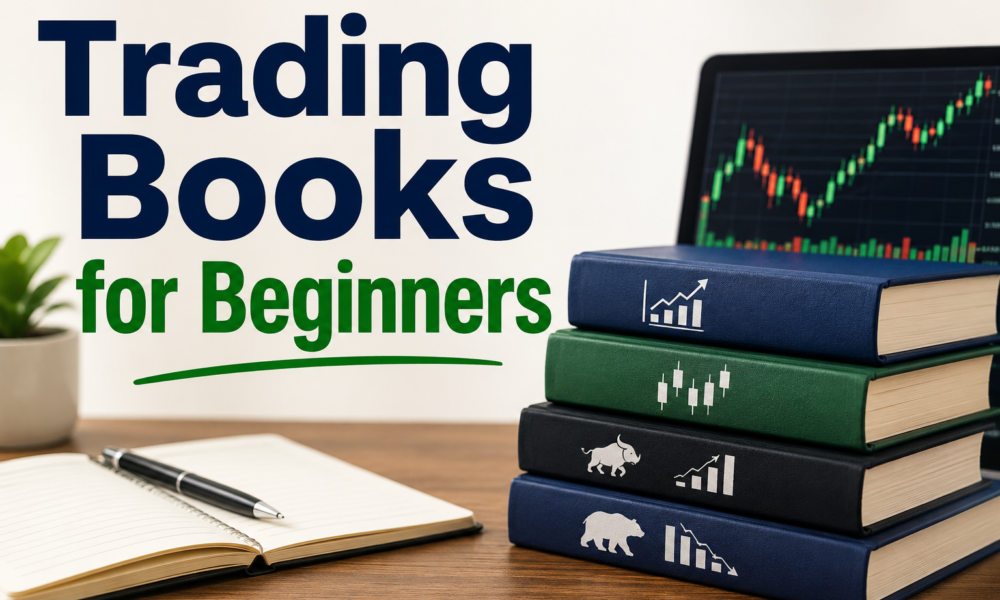
Trading Books for Beginners: 5 Must-Read Books to Build a Strong Foundation
Let me be honest with you for a second. When most people start trading, they don’t read books. They watch YouTube shorts, follow some guy on Twitter who posts PnL screenshots, and then put...

Let me be honest with you for a second.
When most people start trading, they don’t read books. They watch YouTube shorts, follow some guy on Twitter who posts PnL screenshots, and then put money in a stock because their cousin said it was “a sure shot.” That’s not trading. That’s gambling with extra steps.
I’m not judging; most of us start exactly like that. But at some point, if you are serious about this, you have to sit down with actual trading books for beginners and go through the stuff that does not fit in a 60-second reel.
If you are looking for trading books for beginners in 2026, this list will save you time and help you build a better foundation.
Table Of Content
Why Trading Books for Beginners Matter
Here’s the thing about books to learn stock market trading: they force you to slow down. The market moves fast. Your emotions move even faster. A book puts a pause button on all of that and makes you actually think.
Many new traders make costly mistakes because they skip structured learning and jump in too fast. Not because reading makes you lucky, but because learning how to trade from books teaches you to think in frameworks. You stop reacting. You start analyzing.
Books build three things that matter most:
- Discipline — because rules written down are rules you actually follow
- Psychology — because fear and greed are what really kill trades, not bad charts
- Risk management — because knowing how to lose small is more important than knowing how to win big
You won’t get those three things from a Telegram channel.
According to SEBI Investor Education Portal, investor awareness and financial education play a crucial role in helping market participants make informed decisions and avoid common investing mistakes.
How I Chose These Top 5 Books for Trading
This isn’t a “top 10 books you must read” list I pulled from some random website. These are books that are genuinely useful for someone starting, whether you are looking at intraday, swing trading, or even trying to understand F&O basics.
I kept a few things in mind while picking them:
- Is it actually readable for a beginner?
- Does it work for traders in India, not just on Wall Street?
- Does it cover both strategy AND mindset?
- Is it something you’d come back to after 2 years of trading and still find useful?
The best books for trading for beginners are usually not the most complicated ones. They are the ones that stick with you.
These are widely recommended trading books for beginners and serious traders.
Top 5 Books for Trading Every Beginner Should Read
1. Reminiscences of a Stock Operator — Edwin Lefèvre
Originally published in 1923, this classic is still one of the most recommended trading books.
It is a fictionalized account inspired by Jesse Livermore, a guy who made and lost millions multiple times in his life. Technically, it’s fiction, but it is based so closely on Livermore’s real life that most traders treat it as a biography.
What makes it one of the best books for trading is that it does not teach you indicators or chart patterns. It teaches you how the market actually behaves, how crowds move, how manipulation happens, and how your own confidence can destroy you right after your biggest win.
Who should read it?
Literally anyone. Even if you have never bought a single share in your life, this book will teach you more about market psychology than most paid courses will.
One thing that will stay with you: Livermore kept saying the big money was not made in the buying and selling, it was made in the waiting. That one line is worth the entire book.
2. Market Wizards — Jack D. Schwager
This is one of those books that makes you go, “Okay, so there is no one right way to do this.
Jack Schwager interviewed some of the best traders in the world, trend followers, stock pickers, options traders, futures guys, and basically asked them how they do it. Every single person has a different method. Different risk rules. Different styles. Some hold trades for months, some for minutes.
It’s actually reassuring for beginners, because you stop thinking there is one magic formula you are missing.
What’s common across all of them, though? Risk management. Every single trader in this book talks about how they think about losses before they think about profits. That’s the real lesson in Market Wizards.
This is one of the must-read books for traders in India, especially if you are feeling like you need to “find your strategy.” Read this, and you will understand that your strategy has to match your personality.
3. Trading in the Zone — Mark Douglas
If there is one book on this entire list that I’d call non-negotiable, it’s this one. Trading in the Zone is widely considered one of the best books on trading psychology.
Mark Douglas doesn’t talk about moving averages or candlestick patterns. He talks about why you move your stop loss even though you promised yourself you wouldn’t. Why do you hold a losing trade hoping it will come back? Why do you feel sick after a winning trade because you exited too early?
This is one of the best books for trading psychology because it goes deep into the mental patterns that mess traders up, and it’s not vague advice like “control your emotions.” Douglas actually explains why traders do self-destructive things and gives you a framework to think differently.
If you have been trading for even a month and you have made emotional decisions (everyone has), this book will feel like it was written specifically about you. In the best possible way.
4. Technical Analysis of the Financial Markets — John J. Murphy
Okay, this one is not a casual weekend read. It’s a proper textbook. Dense, detailed, and long.
But if you want to understand charts, really understand them, not just know what an RSI is because someone mentioned it, this is the book. It covers everything: support and resistance, trend lines, chart patterns, volume, moving averages, oscillators, and more.
For anyone doing intraday trading or studying Nifty and Bank Nifty charts, this is genuinely one of the best technical analysis books for trading. It’s also one of the best books for intraday trading because it gives you the complete vocabulary and logic behind reading price action.
New traders can also complement book-based learning with the educational resources available through NSE Academy & Market Education.
Don’t try to read it cover to cover in a week. Read the chapter on trends. Apply it. Then read the chapter on support and resistance. Apply that. Treat it like a reference book, not a novel.
It’s also helpful if you are getting into F&O trading, since understanding price structure is the foundation of every options strategy that actually works.
5. The Psychology of Money — Morgan Housel
This is the one that surprises people when they see it on a trading list.
It’s not strictly a trading book. It’s about how people think about money, their blind spots, their biases, the stories they tell themselves. But that’s exactly why it belongs here.
Most trading mistakes aren’t about charts. They are about behavior. Greed when you are on a winning streak. Panic when the market drops. Overconfidence after a good month. Housel writes about all of this in a way that feels more like a conversation with a smart friend than a finance lecture.
This is one of the most useful books for trading in India right now, not because it’s about Indian markets specifically, but because the behavioral patterns it describes are universal. You will recognize yourself on almost every page.
The core message: being good with money is less about intelligence and more about how you behave when things get uncomfortable. That applies to trading more than almost anything else.
How to Read These Trading Books the Right Way
Here’s what NOT to do: buy all five at once, start three of them, finish none of them, and then say books don’t help.
If you are serious about using trading books for beginners the right way:
- Read one at a time. Finish it. Actually finish it.
- Write things down while you read. Even one line per chapter. The act of writing it makes it stick.
- After each book, pick ONE idea and apply it to how you trade. Just one. Not ten. One.
- Come back to the book after six months of trading. You’ll be shocked at how much more you understand the second time around.
And yes, are trading books enough to learn trading? No. They’re not. You have to trade to learn trading. Books give you a map. The market teaches you what the map actually feels like on the ground. But going into the market without reading first is like hiking without a map at all.
The rapid growth in retail investor participation in India highlights the importance of structured learning before entering the markets. Official market statistics are regularly published by National Stock Exchange (NSE) and BSE India.
Final Thought
These are genuinely the must-read books for traders in India, not because they are famous, but because they work. Between the five of them, you’ve got trading psychology, technical analysis, risk management, and the behavioral side of money all covered.
Start with whichever one pulls you in. But start.
The market will always be there. The question is whether you show up to it prepared or not.
Frequently Asked Questions
Which book is best for trading for beginners?
Start with Reminiscences of a Stock Operator if you want something that reads like a story and teaches naturally. If you’ve already been trading for a bit and keep making emotional mistakes, go straight to Trading in the Zone. It’ll hit differently.
Are trading books enough to learn trading?
No, and any good trading book will actually tell you that. Books build your thinking. Real trades, real losses, and honest self-reflection build your skill. You need both. Books without practice is just theory. Practice without books is just expensive trial and error.
Which book is best for trading psychology?
Trading in the Zone by Mark Douglas. It’s not even close. It directly addresses the mental patterns that cost traders money, without being vague or preachy about it. Read it once when you start, and once again after your first rough patch in the market.