




Types of Stock Exchanges in India: NSE, BSE & More
Imagine you invest ₹10,000 in an IPO. Where does that money go first? And later, when you sell those shares on your app, what changes hands? Understanding this journey helps you see how the types of...

Imagine you invest ₹10,000 in an IPO. Where does that money go first? And later, when you sell those shares on your app, what changes hands? Understanding this journey helps you see how the types of stock exchanges in India work and where different securities are traded.
Table Of Content
- What Is a Stock Exchange?
- The Primary Market: Where Companies Raise Money
- The Secondary Market: Where Investors Trade
- Key Functions of a Stock Exchange
- Mapping the Stock Exchanges in India
- Classifying Exchanges by Function
- Real-Life Scenarios
- Common Myths and Confusions
- How Investors Can Use This Knowledge
- Conclusion
Here’s what you will learn:
- What a stock exchange is and how a stock exchange works
- The difference between the primary market and the secondary market
- The major stock exchanges in India and where shares are traded
- The key functions and categories every investor should know
What Is a Stock Exchange?
A stock exchange is an organised, SEBI-regulated marketplace where buyers and sellers trade shares, bonds, derivatives, and other securities. Orders go through SEBI-registered stockbrokers, and the exchange runs the electronic infrastructure for order matching. Securities are usually held electronically through a demat account.
A few terms often get confused: the stock exchange is the platform itself; the stock market is the whole ecosystem of exchanges and investors; a stockbroker places your order; a demat account stores your securities; and a trading account is used to place buy/sell orders.
The Primary Market: Where Companies Raise Money
Let’s start with what the primary market is. This is where new securities are issued for the first time; a company raises money by issuing fresh shares, bonds, or debentures. An IPO, like Zomato’s or LIC’s, is a common example.
When you apply in a fresh issue, the money generally goes to the company itself, subject to how the issue is structured. Exchanges provide the platform, but the issuer receives the funds. Once allotted and listed, shares become listed securities that trade freely later.
Key players in the primary market:
- Issuing Company
- Investors
- Merchant Bankers
- Registrars
- Stock Exchanges and SEBI.
This stage is the foundation for grasping the different types of stock exchanges and the roles each one plays.
The Secondary Market: Where Investors Trade
The secondary market is where already-issued securities are bought and sold between investors. The company does not receive fresh funds when shares change hands.
NSE and BSE are major platforms for equity trading, while MCX and NCDEX handle commodities. Investors trade through brokers, usually using mobile apps.
When you tap “Buy” or “Sell,” the order goes through your broker to the exchange, enters the electronic order book, and is matched with another order. Once matched, the trade is executed, followed by clearing and settlement. The shares or funds then reach your demat and trading accounts.
The key difference between the primary and secondary markets is simple: the primary market involves new securities being issued, while the secondary market involves reselling existing securities.
Key Functions of a Stock Exchange
- Facilitates buying and selling — brings buyers and sellers together on one electronic platform.
- Enables price discovery — prices are set by demand and supply; more buyers push prices up, heavy selling pushes them down.
- Provides liquidity — how easily you can buy or sell a security without moving its price.
- Helps companies raise capital — listing gives businesses access to a wider investor base.
- Promotes transparency — companies must disclose results and corporate actions.
- Supports market regulation — SEBI’s oversight ensures investor protection and fair trading.
Mapping the Stock Exchanges in India
Now that you know the difference between the primary market and secondary market, let’s see where these trades happen. SEBI maintains the list of SEBI-recognised stock exchanges.
1. NSE (National Stock Exchange)
The National Stock Exchange (NSE) offers equity, equity derivatives, and debt trading. Its benchmark index is the Nifty 50. NSE is among India’s largest stock exchanges by trading activity and is widely used by retail and institutional investors.
2. BSE (Bombay Stock Exchange)
Founded in 1875, the Bombay Stock Exchange (BSE) offers equity trading, derivatives, an SME platform, and debt products. Its flagship index is the Sensex. BSE also operates India INX at GIFT City.
NSE vs BSE
Both NSE and BSE list many of the same companies, but they differ in areas such as benchmark indices, trading systems, and liquidity. For most retail investors, choosing between NSE and BSE often depends on factors such as the stock being traded and the broker’s available features.
3. CSE (Calcutta Stock Exchange)
The Calcutta Stock Exchange (CSE) is a SEBI-recognised stock exchange, but it has very limited relevance for retail investors today. Its operations and status have also been subject to regulatory review.
4. India INX
India International Exchange (India INX) is based at GIFT City, Gujarat, and operates under the International Financial Services Centre (IFSC) framework. It offers products such as equity derivatives, currency derivatives, commodity derivatives, and debt securities. Unlike NSE and BSE, its activities are more closely linked to international financial markets than domestic retail trading.
5. MCX (Multi Commodity Exchange)
The Multi Commodity Exchange (MCX) primarily focuses on commodity derivatives. Popular contracts include:
- Gold
- Silver
- Crude oil
- Base metals
MCX is one of the key exchanges for commodity trading in India.
6. NCDEX (National Commodity & Derivatives Exchange)
The National Commodity & Derivatives Exchange (NCDEX) primarily focuses on agricultural commodity derivatives. Its product focus includes commodities such as oilseeds, spices, and other agricultural products.
MCX vs NCDEX
The main difference between MCX and NCDEX is their product focus. MCX is more prominent in metals and energy commodities, while NCDEX has a stronger focus on agricultural commodities.
India’s Major Stock and Commodity Exchanges
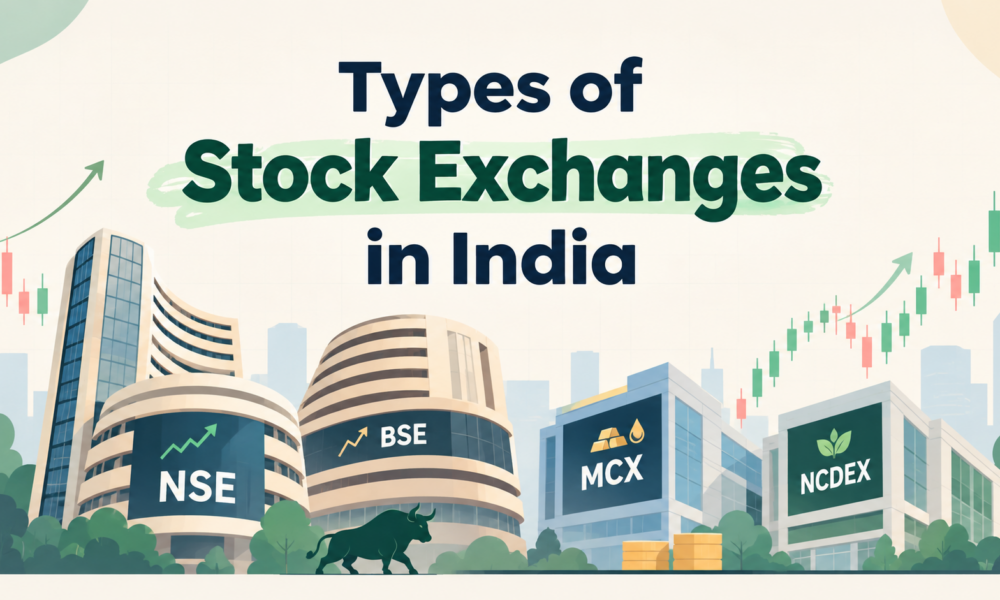
Together, NSE, BSE, MCX, and NCDEX form an important part of India’s financial-market infrastructure. They cover equity, derivatives, debt, and commodity markets and operate within India’s regulatory framework. NSE and BSE also provide debt-market segments for securities such as government and corporate bonds.
Quick Comparison Table
| Exchange | Main focus | Examples of products |
| NSE | Equity, equity derivatives and debt | Shares, Nifty futures and options, bonds |
| BSE | Equity, derivatives, SME and debt | Shares, Sensex-linked products, SME shares, bonds |
| MCX | Commodity derivatives | Gold, silver, crude oil, base metals |
| NCDEX | Agricultural commodity derivatives | Guar seed, spices, oilseeds and other agri products |
| India INX | International-market-linked products | Equity, currency and commodity derivatives, debt securities |
Product availability, contract specifications, eligibility, and risk levels differ by exchange and broker; not every product is available to every investor under identical conditions.
Classifying Exchanges by Function
Instead of memorising names, it helps to classify the types of stock exchanges by what they do:
- Capital-raising platforms — support IPOs and rights or bond issues; the primary market issues new securities, while listing enables later trading.
- Daily trading venues — NSE and BSE for shares and equity derivatives; MCX and NCDEX for commodity futures.
- Product specialists — equity (NSE, BSE), commodity (MCX, NCDEX), international-linked (India INX), and debt (NSE, BSE).
Real-Life Scenarios
- Applying for a tech company’s IPO — primary market; fresh, not-yet-listed shares.
- Buying 10 Reliance shares on your app — secondary market, NSE/BSE; buying IPO and listed shares from another investor.
- Trading a Nifty 50 futures contract — secondary market, NSE; an equity derivative.
- Trading gold or crude oil futures — secondary market, MCX; a commodity derivative.
- Buying a government bond through a broker — primary or secondary depending on issuance, NSE/BSE debt segment.
Notice how applying for an IPO differs from the later listing and trading of those shares, a distinction that trips up many beginners exploring the types of stock exchanges for the first time.
Common Myths and Confusions
- “Primary market is only for rich investors.” Retail investors can apply too, subject to issue rules and risks.
- “NSE and BSE can’t trade the same stock.” The same company can be listed on both; access depends on your broker.
- “MCX is a stock exchange like NSE.” Not quite; MCX focuses on commodity trading, not company shares.
- “Primary and secondary markets are different buildings.” They’re market stages, not physical places.
- “Buying a share always sends money to the company.” Usually you’re buying from another investor; the company gets funds mainly when it issues securities in the primary market.
Clearing up these myths helps you understand the different types of stock exchanges and how they fit together.
How Investors Can Use This Knowledge
- IPO investors: read offer documents and remember listing doesn’t guarantee profit.
- Long-term equity investors: know where shares are listed and traded, and check liquidity and disclosures first.
- Derivatives traders: identify the underlying asset, expiry, and margin; derivatives can magnify losses.
- Commodity participants: learn contract specifications; prices react to global markets, weather, and currency moves.
Conclusion
Understanding the types of stock exchanges in India makes it easier to know where different securities are traded and how the market works. Whether you’re applying for an IPO, buying shares on NSE or BSE, or trading commodities through MCX or NCDEX, knowing the market and exchange involved can help you make more informed decisions.