




The Role of ETFs in Building a Balanced Stock Portfolio
ETFs have been having a moment for a while now! After a rough patch amidst the 2019 pandemic, they’re back stronger than ever. Investors are pouring money into ETFs, new ones are constantly...

ETFs have been having a moment for a while now! After a rough patch amidst the 2019 pandemic, they’re back stronger than ever. Investors are pouring money into ETFs, new ones are constantly popping up, and tons of new products are splurging in. No wonder the total amount of money invested in ETFs has almost tripled from $3.4 trillion in 2016 to over $10 trillion as of November 2021.
Table Of Content
- What Are ETFs? A Comprehensive Overview
- The Benefits of Using ETFs in Your Investment Strategy
- How do ETFs Enhance Portfolio Diversification?
- Types of ETFs: Finding the Right Fit for Your Goals
- Key Factors to Consider When Choosing ETFs
- Strategies for Incorporating ETFs into Your Portfolio
- Common Mistakes to Avoid with ETFs
- Conclusion: The Future of ETFs in Stock Market Investing
Let’s dive into the role of ETF investing in building a balanced portfolio.
What Are ETFs? A Comprehensive Overview
ETFs, or Exchange-Traded Funds, are investment vehicles that trade on a stock exchange like individual stocks. They are designed to track the performance of an underlying index, basket of assets, or commodity. Think of ETFs as baskets of stocks or bonds. Instead of buying individual stocks, you buy a basket with many. This way, you get a little bit of everything in one package.
The Benefits of Using ETFs in Your Investment Strategy

Following are some of the many benefits of ETF investing:
- Less Risk: Spreading your money across lots of investments is like wearing a seatbelt – it protects you from a bumpy ride.
- Lower Costs: ETFs are usually cheaper to buy and sell than other investments.
- Flexibility: Like stocks, you can buy and sell ETFs whenever the market is open.
- Transparency: ETFs disclose their holdings on a day-to-day basis, providing you with transparency into the underlying assets.
- Taxation: ETFs often save you money on taxes. This is because they’re created and redeemed in a way that helps you avoid paying taxes on capital gains.
How do ETFs Enhance Portfolio Diversification?

Imagine a buffet – you don’t want to eat just one dish, right? You want a variety to get all the nutrients. ETFs are like that buffet for your investments.
Why is Diversification Important?
- Risk Reduction: It’s like spreading your bets. If one investment does poorly, others might do well, balancing things out.
- Better Returns: Over the long term, a balanced portfolio of stocks tends to perform better than one focused on a single investment.
How do ETFs help with diversification?
ETF investing helps with diversifications in the following ways:
- Broad Exposure: ETFs can hold hundreds or even thousands of stocks or bonds, exposing you to a wide range of assets.
- Different Asset Classes: With ETF investing, you can track stocks, commodities, bonds, or real estate.
- Global Reach: Some ETFs invest in companies worldwide, helping you diversify across different markets.
Balanced investment portfolio example:
Imagine you want to invest in the Indian stock market. Instead of picking individual stocks like Reliance, HDFC Bank, and TCS, you could invest in an Nifty 50 ETF. This ETF tracks the performance of the 50 largest companies in India. Investing in this ETF automatically diversifies your well-balanced stock portfolio across a wide range of industries and sectors.
For instance, let’s say the Nifty 50 ETF you invest in has 50 stocks. If 10 of those stocks perform poorly, your overall investment won’t be significantly impacted because the other 40 stocks are likely doing well.
Types of ETFs: Finding the Right Fit for Your Goals
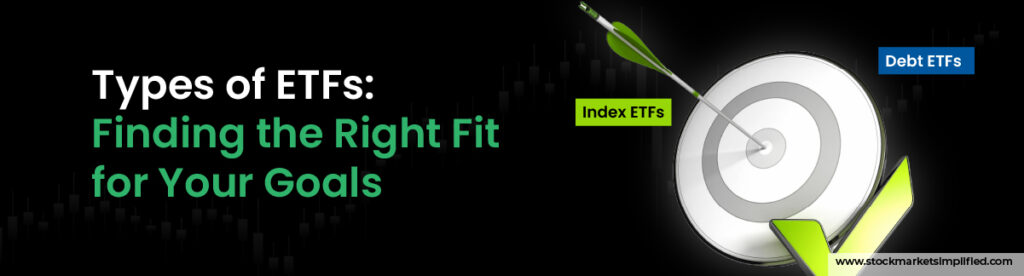
- Index ETFs: These track the whole market, like the Nifty 50 or Sensex. It’s like getting a taste of everything.
- Debt ETFs: If you’re looking for a safer investment, these focus on bonds like loans to governments or companies.
- Gold ETFs: Want to invest in gold without physically owning it? You can choose gold ETFs, which track the price of gold.
- International ETFs: If you want to explore global markets, international ETFs are the ones that invest in companies outside of India.
- Sector/Thematic ETFs: Interested in a specific industry like tech or healthcare? These ETFs focus on companies in that area.
- Smart Beta ETFs: These ETFs use special strategies to pick stocks instead of just following the market.
Which type is right for you, you may wonder. Well, it depends on your goals and risk tolerance. If you’re new to investing, an index ETF might be a good starting point. You might consider a sector or thematic ETF if you’re looking for higher returns. And if you want to reduce risk, a debt ETF could be a good option.
Key Factors to Consider When Choosing ETFs
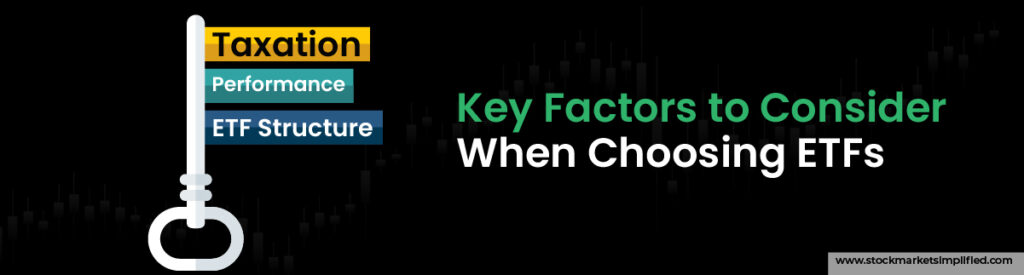
Costs
There are two main costs involved with ETFs. The first is transaction fees, which are charged when you buy or sell an ETF. The second is the expense ratio, which is the annual fee charged by the ETF management company. Lower expense ratios generally mean higher returns.
ETF Structure
Understand if the ETFs have a physical or synthetic structure. Physical ETFs directly invest in the underlying assets of the index, while synthetic ETFs use derivatives. Understand the structure and its associated risks.
Performance
Measure how closely the ETF’s returns match the underlying index’s returns. A lower tracking error is generally better. Also, evaluate how consistently the ETF tracks the index over time.
Taxation
Some ETFs may offer tax advantages, such as lower capital gains taxes, while some may not. In India, most equity ETFs offer a tax exemption of up to Rs. 1,00,000 on long-term capital gains.
Strategies for Incorporating ETFs into Your Portfolio
ETFs are like a Swiss Army knife – they’re super versatile! Here are some ways to use them in your investment strategy –
Asset Allocation
ETFs offer investors exposure to several asset classes, including equities, fixed income, commodities, and real estate and allow you to easily allocate your investments across these different asset classes. This helps manage risk and potentially improve returns.
Swing Trading
ETF investing can be used by short-term traders to capitalize on short-term price fluctuations. However, swing trading requires active management and can be riskier.
Sector Rotation
ETFs can be used to invest in specific market sectors, allowing you to capitalize on industry trends. This requires careful analysis and timing.
Dollar-Cost Averaging
Investing a fixed amount in ETFs regularly can help you average out the cost of your investment over time, reducing market volatility’s impact on the same.
Common Mistakes to Avoid with ETFs

- Chasing Hot Trends: Don’t just jump on the bandwagon. Do your research before investing in ETFs.
- Ignoring Fees: Watch out for high fees, which can eat into your returns.
- Overlooking Liquidity: Make sure you can buy and sell your ETFs easily.
- Ignoring Tax Implications: Understand how ETFs are taxed to avoid surprises.
Conclusion: The Future of ETFs in Stock Market Investing
ETFs have exploded in popularity in recent years, and this trend is expected to continue. Many experts believe that global ETF stock under management (AUM) will surpass $20 trillion by 2026, driven by factors such as record inflows, new product offerings, and expanding distribution channels. This growth highlights the increasing appeal of ETFs as a flexible and efficient investment tool for investors worldwide.