




Complete Guide To Candlestick Patterns: How To Interpret Charts and Identify Trading Opportunities
Every professional trader starts by reading candlesticks. Here’s why. You open a chart, see rows of red and green bars, and think, What am I even looking at? That was me too, when I first...

Every professional trader starts by reading candlesticks. Here’s why.
Table Of Content
You open a chart, see rows of red and green bars, and think, What am I even looking at? That was me too, when I first started. But here’s the thing: once it clicks, you will wonder how you ever traded without it. So what are candlestick patterns for beginners? They are visual formations on a price chart that show exactly what happened during a trading session, who was buying, who was selling, and who came out on top.
A candlestick chart doesn’t just show where the price ended up. It shows the whole journey, the highs, the lows, the opens, the closes. That’s what gives it an edge over a plain line chart. It captures market sentiment, the collective mood of thousands of traders, in a single bar.
According to Groww, there are 38 distinct bullish and bearish candlestick patterns you can study. But honestly? You don’t need all 38. This guide covers the ones that show up the most and actually tell you something useful.
What is a Candlestick Chart?
Think about a candlestick pattern as a daily grade sheet for a company. The candle shows four main things:
- The opening price
- The closing price
- The highest price
- The lowest price
That’s four data points in one clean visual, compared to a line chart that shows you only the closing price. No wonder serious traders use it.
Here’s how to read each part of the candle:
• Body: The thick rectangle in the middle. It covers the range between the open price and the close price. Big body = strong move. Small body = not much conviction.
• Wick / Shadow: The thin lines sticking out above and below the candle body. Upper candle wick = highest price reached. Lower shadow = lowest price touched in that session.
• Colour: Green (or white) means price closed above where it opened, bullish. Red (or black) means it closed below the open, bearish.
Let me show you how to plot the candlestick chart through an example. Suppose the opening price of the stock is ₹100 (opening price). The price goes up to ₹110 (the highest price), drops to ₹95 (the lowest price), and finally closes at ₹107 (the closing price). In such a situation, the candle’s body will range from ₹100 to ₹107. The upper part of the candle will go upward from ₹107 to ₹110, whereas the lower end of the candle will come down to ₹95.
This is practically all that you must know about charts. With this information, the rest becomes easy to figure out. As Investopedia notes, “the candlestick chart is much more informative in nature on a bar-to-bar basis compared to the line chart.” If you need help with understanding charts, make sure to go through this Dukascopy article meant for beginners.
As time goes by, and you keep learning about charts, you’ll start recognizing patterns in them.
What are Candlestick Patterns
Indeed, every chart is a conflict between the buyers who wish to increase the price and the sellers who struggle to hold down the price. Based on the outcome of the battle for every period of the day, we will determine the winner, the size of his victory, and the reaction from the opposing side.
Candlestick chart patterns reading does not imply that you will definitely be able to predict what is going to happen further. In general terms, it implies knowing about the likelihood of something happening. Identifying a recognized candlestick chart pattern in the right place on the chart might give you an advantage, although there will be no warranty of success. This method relies on the fundamentals of candlestick charting techniques, presented in the previous section.
Two general categories will cover most of your needs:
Bullish candlestick patterns:
- Buyers are winning.
- Price is likely heading up or bouncing off a low.
Bearish candlestick patterns:
- Sellers are winning.
- Price is likely heading down or reversing off a high.
The psychological state involved in price change, whether greed, panic, or indecisiveness, is another important lesson from candlestick patterns apart from the indication of trend. An example of a candle with a small body and long wicks means the market was trying to go two ways at once, which resulted in no change in price at all.
Japanese candlestick charts were built around the idea that the story of each session matters as much as the price itself. As QuantInsti explains, understanding that story is what separates traders who react to moves from traders who anticipate them.
Types of Candlestick Patterns
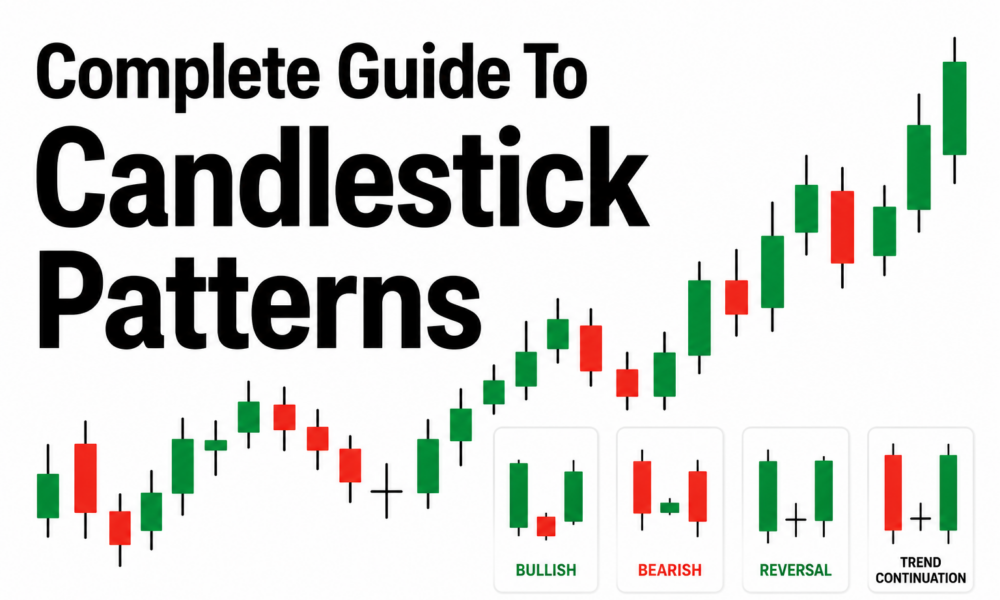
Before you memorise individual setups, it helps to know how candlestick pattern examples are grouped. There are three main types, based on how many candles it takes to form them:
| Category | Patterns | Candles | What It Signals |
| Single-Candle | Doji, Hammer, Shooting Star | 1 candle | Reversal at support/resistance |
| Two-Candle | Bullish/Bearish Engulfing, Harami | 2 candles | Trend continuation or reversal |
| Three-Candle | Morning Star, Evening Star, Three Black Crows | 3 candles | Strong reversal signals |
Single-candle patterns are the easiest to notice: Doji, Hammer, Shooting Star. Just one session and just one decision. They prove to be the most helpful when they occur just at a support or resistance point, since that is precisely the moment they have an informational value. Examples of two-candle patterns, such as Engulfing or Harami patterns, require a period of two sessions to emerge. It is an additional factor providing an extra piece of evidence about trend continuation or reversal.
Examples of three-candle patterns are called Morning Star and Evening Star. Three candles mean additional time for analysis; however, the longer period provides more information already. In the Chart Guys cheat sheet, you can find over 35+ patterns divided by the above three groups. It might be helpful for your further reference. As for visual examples of patterns, there is an interactive ChartGuys’ sheet.
The 7 Best Candlestick Patterns for Day Trading
These are the most powerful patterns for trading, not because I picked them randomly, but because they are the ones that keep showing up on real charts, in real markets, with well-documented accuracy behind them. Get comfortable with these seven before you chase anything more exotic.
1. Hammer Pattern (Bullish Reversal)
If you only learn one of the bullish candlestick patterns, make it the Hammer. Small body sitting at the top, long lower wick stretching down, that wick should be at least 2–3 times the body length. You’ll see it at a support level after a downtrend. What it’s telling you: sellers pushed hard, buyers pushed back harder, and the price ended up near the high of that candle.
According to Bookmap, when confirmed by the next candle, the Hammer hits about 83% accuracy. That’s a number worth respecting.
2. Bullish Engulfing (Bullish Reversal)
This two-candle setup is one of the more satisfying bullish candlestick patterns to spot. A red candle forms first. Then, the very next session, a green candle opens below the red candle’s close and closes above its open, completely swallowing it. That’s a bullish engulfing. It tells you buyers didn’t just show up, they showed up with force. Best when it appears at a support level after a sustained drop, where it confirms the sellers have run dry.
3. Doji (Indecision / Potential Reversal)
The Doji is probably the easiest to interpret chart because it simply does not give a damn! The reason behind this is that a Doji is a candlestick in which the closing price will be almost equal to the opening price, creating a little body with wicks on either side. None of the above could win. However, if the Doji comes out of the support/resistance lines, after a trend, this is a reversal pattern!
4. Shooting Star (Bearish Reversal)
Just reverse a Hammer pattern, and you get a Shooting Star, which happens to be a neat bearish candlestick pattern. It features a small body located towards the bottom with a long upper shadow going up. It shows up on the charts when there is resistance after the prices have appreciated. The information obtained from the pattern seen in this chart is that buyers were making their best efforts to continue the bullish trend, but in the end, sellers gained control, forcing the price down.
5. Bearish Engulfing (Bearish Reversal)
Just like the bullish engulfing, but flipped. A green candle forms, then in the next session, a red candle opens above it and closes below it, a full bearish engulfing. Sellers didn’t just outperform; they erased the previous session. Among bearish candlestick patterns, this one tends to hit hard and fast. When it shows up at a resistance level after an uptrend, start watching for follow-through. Don’t jump in until the red candle has fully closed.
6. Morning Star (Bullish 3-Candle Reversal)
Three candles, three acts. A red candle shows sellers in control. The middle session, small-bodied or a Doji, shows the selling slowing down. Then a strong green candle closes the sequence, telling you buyers are back. That’s the Morning Star. It’s one of the candlestick pattern that traders genuinely get excited about because the trend reversal case is built across three sessions. A Morning Star near a major support zone, with solid volume behind it, is a high-quality setup.
7. Three Black Crows (Bearish 3-Candle Reversal)
Three red candles in a row, each one opening inside the previous candle’s body and closing lower. No bounce, no pause, just sustained selling. The Three Black Crows is a chart formation that removes all doubt about where momentum sits. It’s a confirmed trend reversal in slow motion, playing out right in front of you. When this candlestick pattern appears near a key high after a long uptrend, that’s not a place to be looking for buys.
Why Pattern Location Matters
This is an example of something that new traders commonly do wrong: they will learn about a candlestick pattern, identify it on their charts, and jump into the trade right away. It’s all about where that candle is appearing. A Hammer in a consolidation period may mean absolutely nothing. The same Hammer that appears after a solid downtrend on solid volume at support levels? Entirely different trade.
To make candlestick patterns actually work, pair them with:
• Volume: A pattern backed by above-average volume is far more trustworthy. Thin-volume patterns produce false breakouts and pullbacks you don’t want to chase.
• Trend direction: Bullish patterns in strong downtrends fail more often than not. Trade with the trend, not against it. Price action context matters.
• Technical indicators: RSI divergence, a moving average confluence, or a clear chart pattern nearby, these turn a decent setup into a strong one.
The Chart Guys PDF does a good job explaining how support level and resistance level positioning change the reliability of the same patterns completely.
Candlestick Pattern Tips for Beginners
The book “Japanese Candlestick Charting Techniques” provides an amazing guide to this topic. It was written by Steve Nison in 1991, and all that was mentioned is relevant even today. Several decades have gone by since then, yet nothing much seems to have changed in terms of rules. However, it does not take rules, but discipline, to learn Japanese candlesticks.
Things that actually help:
- Wait for confirmation — let the candle after the pattern close in your direction before you enter anything
- Stack your evidence — two or three patterns or indicators pointing the same way beats any single signal
- Backtest on old charts first — before trading these live, find 20–30 historical setups and see how they played out
Things to avoid:
- Trading without confirmation — patterns fail regularly without it; the false signal rate is too high
- Ignoring the broader trend — a bullish setup in a market that’s in freefall is still a bad trade
- Overtrading — not every candle has a story worth acting on. Patience is a strategy
Knowing how to spot candlestick patterns in stock market conditions isn’t just about identifying shapes. It’s about waiting for the right shape at the right place, with the right confirmation behind it. Whether it’s a trend reversal signal or a trend continuation setup, none of these candlestick patterns works in isolation; context is what separates a good trade from a random one.
Practice Candlestick Pattern Trading Today
Learning how to read a chart is an art that improves with practice. Trading doesn’t have to involve 38 different patterns. You just need to begin learning with the 7 candlestick patterns discussed above. Grab old charts and try spotting patterns in markets like Nifty, Reliance, HDFC Bank, and so forth. It will give you better trading intuition.
Once the 7 core patterns feel second nature, then add more. But don’t rush that stage. Most traders who lose money do so because they try to learn too many trading signals too fast and end up confused about all of them.
Download the free candlestick patterns cheat sheet poster from The Chart Guys, stick it next to your screen while you’re learning. It’s a solid quick-reference for every candlestick chart formation we’ve covered, and then some.
Frequently Asked Questions (FAQs)
What are the most profitable candlestick patterns?
The Hammer, Bullish Engulfing, and Morning Star can be considered very reliable patterns. As stated in Bookmap, the Hammer is approximately 83% accurate upon confirmation with the next candle.
How many candlestick patterns should beginners learn?
It is not necessary to know all 38 patterns. One should study seven key patterns presented in this guide first: Hammer, Doji, Engulfing, Shooting Star, Morning Star, and Three Black Crows.
Do candlestick patterns work in all markets?
Candlestick patterns are suitable for trading in the stock market, Forex, cryptocurrency, and commodity markets. Nevertheless, their results tend to be more predictable when combined with volume and trend.
How accurate are candlestick patterns?
Their effectiveness varies depending on patterns and context. For example, the Hammer is about 83% accurate if it is confirmed. On the other hand, patterns in resistance/support areas are more accurate compared to those in the middle of the price range.