





• contact@stockmarketsimplified.com
stockmarketsimplified stockmarketsimplified
  • Home
  • Glossary
  • Contact
Search the Site
Popular Searches:
iPhone Artificial Intelligence Smartphones
Recent Posts
What is the Moving Average Convergence Divergence (MACD) Indicator?
March 29, 2025
What Is the Debt to Equity Ratio Formula and How Does It Work?
March 27, 2025
How to Select Stock for Swing Trading?
March 9, 2025
stockmarketsimplified stockmarketsimplified
  • Home
  • Glossary
  • Contact
Popular News
Understanding the Head and Shoulders Pattern
March 4, 2025
Indian Regulatory Bodies: Guardians of Fair Play
January 19, 2025
Strategic Trading: Explore Different Types of Trading 
January 18, 2025
Follow Us
Subscribe
Home/Glossary/Price to Earnings Ratio (P/E Ratio)
GlossaryGlossary

Price to Earnings Ratio (P/E Ratio)

The P/E ratio is a simple way to figure out how expensive or cheap a company’s stock is on the basis of its profits. It typically compares earnings per share (EPS) of a company with its current...

Suhani
Suhani
December 13, 2024 2 Min Read
7 0

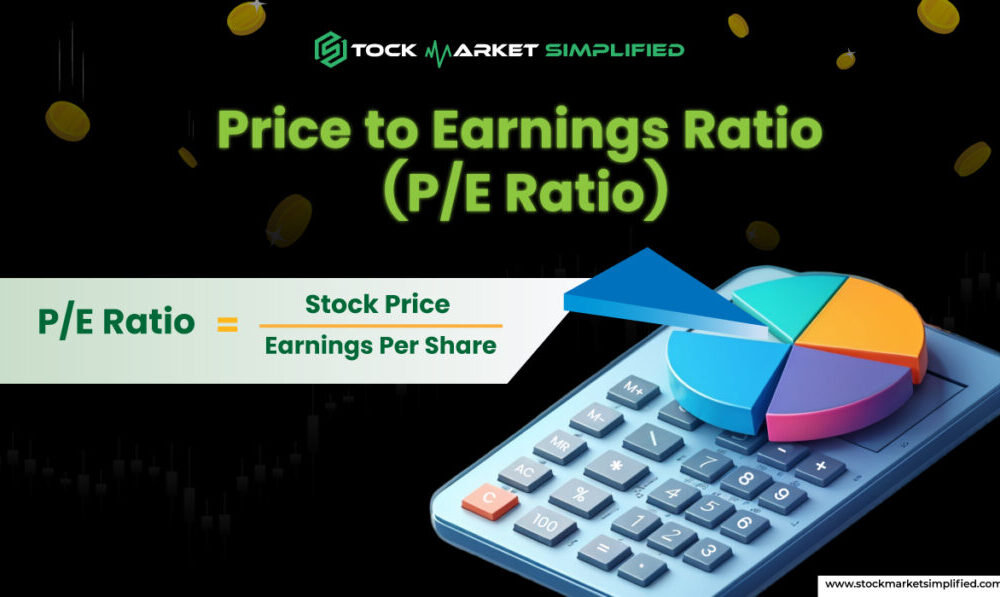
The P/E ratio is a simple way to figure out how expensive or cheap a company’s stock is on the basis of its profits. It typically compares earnings per share (EPS) of a company with its current market price. In other words, a P/E ratio says a lot about you how much investors are ready to pay for every ₹1 the company earns.

Table Of Content

  • Key Formula
  • What It Shows
  • Example
  • What does it mean?
  • Why the P/E Ratio Matters
  • Types of P/E Ratios
  • Why Both Types Matter

Key Formula:

P/E Ratio = Stock Price ÷ Earnings Per Share (EPS)

What It Shows

High P/E Ratio: Means investors feel that the company can grow a lot in the future, so they’re ready to pay more for each share.

Low P/E Ratio: Hints that investors may not feel strongly confident in future growth of the company. Hence, such stocks may be cheaper.

Example:

Suppose an AB company’s stock price is ₹100. Now, let’s take ₹5 as the current EPS.

P/E Ratio of AB = ₹100 ÷ ₹5 = 20

What does it mean?

Every investor is paying an additional ₹20 for every ₹1 the company earns.

Why the P/E Ratio Matters

Mainly, P/E ratio lets investors study overvalued or undervalued stocks easily. But keep in mind:

  • A high P/E doesn’t always mean the company is great.
  • A low P/E doesn’t always mean the company is bad.

It’s just one tool to compare different companies.

Types of P/E Ratios

1. Trailing P/E Ratio

This looks at the company’s past earnings, usually from the last year. It shows how much you’re paying for the money the company has already made.

Formula:

Trailing P/E = Stock Price ÷ Past Earnings Per Share

2. Forward P/E Ratio

This uses future earnings estimates. Forward P/E ratio tells investors how much they are agreeing to pay potential future earnings of a company.

Formula of Forward P/E = Stock Price ÷ Projected Earnings Per Share

Why Both Types Matter

  • Trailing P/E: Based on actual past performance, so it’s reliable but doesn’t show future potential.
  • Forward P/E: Focuses on future predictions, which can be helpful but aren’t always accurate.

The P/E ratio, whether trailing or forward, is a handy tool for comparing stocks and making smarter investment decisions.


Tags:

glossary

Share Article

Suhani

Suhani Content Writer

Suhani is a skilled finance content writer dedicated to creating insightful, engaging, and reader-focused content. With a deep understanding of personal finance, investments, market trends, and financial planning, Suhani excels at turning complex financial topics into simple, actionable insights. From demystifying tax strategies to exploring smart investment options, Suhani provides readers with the knowledge they need to achieve financial success. Known for a professional yet approachable writing style, Suhani blends research, clarity, and creativity to craft content that resonates with diverse audiences. Trusted by clients and readers alike, Suhani is your go-to expert for finance content.

Previous Post

Earnings Per Share (EPS)

Next Post

Initial Public Offering

Top Authors
Manaswi Agarwal
Manaswi AgarwalContent Writer (Finance, Stock market)
50 Posts
Suhani
SuhaniContent Writer
11 Posts
Top Categories
Stockmarket Simplified Stockmarket Simplified
50 Posts
Glossary Glossary
11 Posts
Most Viewed
Understanding the Head and Shoulders Pattern
March 4, 2025
Indian Regulatory Bodies: Guardians of Fair Play
January 19, 2025
Strategic Trading: Explore Different Types of Trading 
January 18, 2025

Related Posts

Glossary
What is the Moving Average Convergence Divergence (MACD) Indicator?
Manaswi Agarwal
By Manaswi Agarwal
Glossary
Short Selling
Suhani
By Suhani
Glossary
Volatility
Suhani
By Suhani
Glossary
Stock Split
Suhani
By Suhani
instagram image
instagram image
instagram image
instagram image
instagram image
instagram image
Instagram
stockmarketsimplified stockmarketsimplified
  • contact@stockmarketsimplified.com
Helpful Links
  • Glossary
  • Contact
  • Privacy Policy
  • Terms And Conditions
Popular Posts
What is the Moving Average Convergence Divergence (MACD) Indicator?
Manaswi Agarwal
March 29, 2025
What Is the Debt to Equity Ratio Formula and How Does It Work?
Manaswi Agarwal
March 27, 2025
How to Select Stock for Swing Trading?
Manaswi Agarwal
March 9, 2025
Follow Us
Facebook
Twitter
Youtube
Instagram
Stay Informed
©Copyright 2026. stockmarketsimplified.com. All Rights Reserved