




10 Common Mistakes in Intraday Trading and How to Avoid Them
A stock jumps sharply within minutes, and a trader buys it so as not to miss the move. The price slips back. The stop-loss is skipped because the stock will surely recover. Then the quantity is...

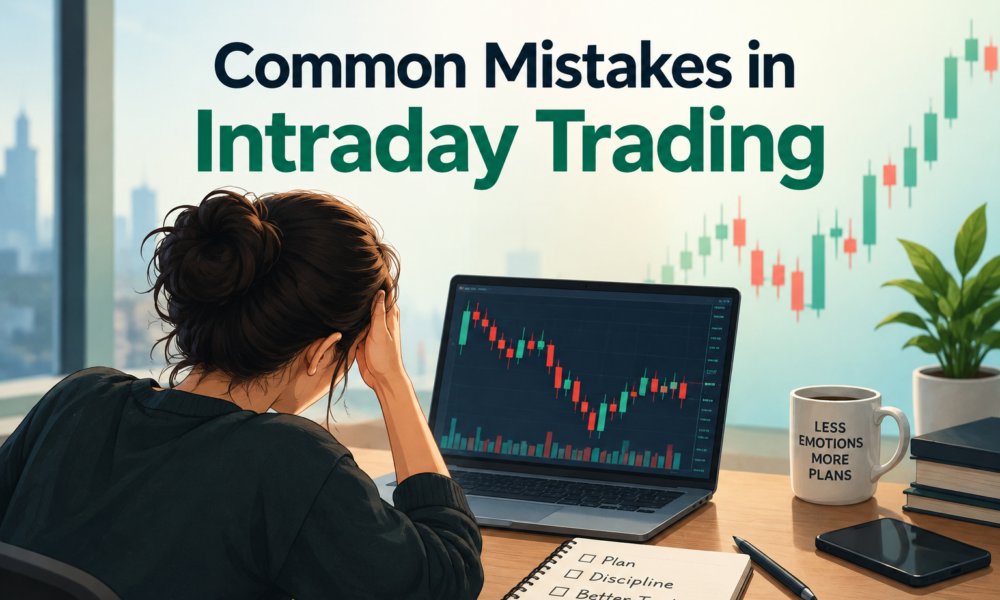
A stock jumps sharply within minutes, and a trader buys it so as not to miss the move. The price slips back. The stop-loss is skipped because the stock will surely recover. Then the quantity is doubled to win the money back faster. One impulsive decision has quietly become three.
Table Of Content
Most common mistakes in intraday trading look something like this. They are rarely just about picking the wrong stock. They usually come from weak risk management, too much leverage, emotional decisions, chasing price, overtrading, ignoring liquidity, or switching strategies every other week.
Common Mistakes in Intraday Trading
Here are ten common mistakes in intraday trading and how to avoid them. This is educational content, not personal advice.
1. Trading Without a Stop-Loss
A stop-loss is an order tied to a price you choose before entering. If the market reaches it, your exit is triggered.
Traders skip it mostly out of hope: “it will come back.” Trading without a stop loss leaves the size of your loss to the market, and one sharp move can turn a small error into a big dent in your capital.
A stop loss in intraday trading isn’t a guaranteed exit price, though. SEBI’s investor material notes that a triggered stop-loss becomes a market or limit order, and a limit order may not fill if the price moves through it. Still, a defined exit is a core part of risk management in trading.
2. Over-Leveraging
Leverage means holding a bigger position than your own money allows, using margin from your broker. Exposure rises, and so does the impact of every price move.
A 1% fall is calculated on the full position, not just the margin you deposited. Losses are magnified the same way gains are, so treat leverage as a risk factor, not a shortcut.
Intraday trading for beginners works best with small quantities. Check your trading capital and risk tolerance first. Plenty of day trading mistakes start with a position that was simply too big for the account.
3. Ignoring the Risk-Reward Ratio
Risk-reward compares what you could lose with what you hope to earn.
Here is an illustrative example: risking ₹3,000 to reach a ₹500 target. Even before brokerage and other transaction costs, you would need to be right very often just to break even.
No ratio guarantees profit, and your win rate matters too. But knowing the potential loss before entry is basic discipline. Fix your entry point, exit point and profit target first. That is the backbone of any intraday trading strategy, and it keeps risk management in trading practical.
4. Chasing Momentum or Price Action
A stock surges, everyone talks about it, and you buy near the top. Momentum and breakouts are real, but by the time a move feels obvious, much of it may be over. Late buyers are the ones exposed to a reversal.
That is FOMO at work. A fast move doesn’t mean you must join it. Plan the entry instead: wait for a pullback towards support or VWAP, or for a breakout backed by volume. Set your stop loss in intraday trading before you buy. Chasing is one of those intraday trading mistakes that feels exciting and costs quietly.
5. Trading Illiquid Stocks
Liquidity is how easily you can buy or sell without moving the price. Check trading volume and the bid-ask spread. A wide spread means you lose money just getting in and out.
In thin stocks, exits can be hard and slippage can be large. SEBI cautions that in some conditions it may be difficult or impossible to close a position at a reasonable price, especially when no orders are waiting on the other side.
One of the simplest intraday trading tips is to check volume before entering, not after you’re stuck. It is also among the common trading mistakes that beginners overlook.
6. Holding Trades Through Major News Events
Company earnings, RBI policy announcements, major economic data, regulatory changes and surprise corporate news can all spike volatility. Spreads widen, slippage rises and prices can jump.
SEBI warns that news combined with lower liquidity and higher volatility can cause unexpected price movements. Even a stop loss in intraday trading may fill far from your trigger in such moments.
This doesn’t mean you must exit before every event. It means understanding the event risk first, then deciding whether to hold, reduce size or stay out.
7. Overtrading Out of Revenge or Boredom
Overtrading means taking more trades than your plan calls for. Two triggers are common. Revenge trading is trying to win back a loss immediately, usually with a bigger position. Boredom is the other: a quiet market feels like wasted time, so you force a trade without a setup.
Every extra trade adds brokerage and transaction costs, and mental fatigue dulls judgment. To avoid overtrading, set a maximum number of trades and a daily loss limit, then stop when you hit it.
It is one of the day trading mistakes that hides well, since each trade looks small, and possibly the hardest of all intraday trading mistakes to spot in yourself.
8. Trading on Emotions and Unverified Rumors
Fear, greed, FOMO and frustration push traders into panic buying and panic selling. Add tips from social media, WhatsApp or Telegram, and it gets worse. Someone posting a “sure shot” call may be wrong, or may already hold the position.
SEBI’s investor material cautions against acting on rumors. Verify what you hear, then ask whether it fits your own setup. If it doesn’t, skip it.
Following blind calls is one of the costlier common trading mistakes. Learning to control emotions starts with rules written before the market opens.
9. Ignoring Technical Analysis and VWAP
Technical analysis helps you read trend, support and resistance, volume and price action. VWAP, the volume-weighted average price, is the day’s average price weighted by how much traded at each level. Many traders use it to judge whether price is above or below that average.
These are tools, not crystal balls. No indicator predicts the market with certainty. NSE’s educational material covers price action, volume and VWAP as basic concepts.
Good intraday trading tips are simple: pick a few tools, learn them well and use them consistently. Intraday trading for beginners doesn’t need a screen full of indicators.
10. Constantly Changing Strategies
Two or three losses, and the strategy gets replaced. It sounds sensible, but a tiny sample can’t tell you whether the method is flawed or you’re in a normal rough patch. Switching too early is one of the common trading mistakes that hides behind good intentions.
Strategy hopping also leaves nothing to review. Write down your rules, test them, and record each trade in a trading journal: entry, exit, reason and how you felt.
Consistency won’t make an intraday trading strategy profitable. It simply lets you judge your process fairly.
Quick Summary Table
Here is a quick look at the intraday trading mistakes above and what to do instead.
| Mistake | What Can Go Wrong | Better Practice |
|---|---|---|
| Trading without a stop loss | Loss can grow unexpectedly | Define risk before entry |
| Over-leveraging | Losses are magnified | Match position size to risk |
| Poor risk-reward | Potential loss may outweigh reward | Assess risk before entry |
| Chasing momentum | Late entry can face reversal | Wait for a defined setup |
| Illiquid stocks | Exit may be difficult | Check liquidity and volume |
| Trading through news | Volatility and slippage can rise | Know the event risk |
| Overtrading | Costs and emotional pressure increase | Trade only planned setups |
| Rumor-based trading | Decisions may rely on unreliable information | Verify before acting |
| Ignoring technical tools | Context may be missed | Use analysis consistently |
| Strategy hopping | Performance is hard to evaluate | Keep a defined process |
A Simple Intraday Trading Checklist
Keep these intraday trading tips near your screen. A short routine keeps risk management in trading from staying theoretical.
Before entering
- Do I have a clear setup from my intraday trading strategy?
- Where is my exit if the trade goes against me?
- Is the potential loss acceptable?
- Is the stock liquid enough?
- Is major news expected?
- Am I entering because of a plan or an emotion?
During the trade
- Am I following the plan?
- Am I adding to the position because of a loss?
- Am I chasing price?
After the trade
- Did I follow my rules?
- What worked, and what went wrong?
- Has it been recorded in my trading journal?
Common Questions
Is intraday trading very risky?
It can be. Prices move quickly, leverage magnifies outcomes, and positions must be closed the same day. How risky it is depends on position size, discipline and your plan.
What is the biggest mistake in trading?
There is no single answer, but trading without a stop loss and oversized positions are frequent day trading mistakes.
Can I earn ₹1,000 a day?
Nobody can promise a fixed daily income. Some days bring losses. Treat any such promise as a warning sign.
Why do people say most day traders lose?
I won’t quote a percentage without a current, reliable source. The reasons are easier to see: costs, leverage, overtrading, emotional decisions and no plan. These are the intraday trading mistakes covered above.
Final Thoughts
Better intraday trading isn’t only about finding the next entry. It’s about knowing your exit, sizing positions sensibly, following a written plan, keeping emotions in check and reviewing trades afterwards. Those habits keep common mistakes in intraday trading from piling up.
Intraday trading for beginners feels far less stressful when every trade has rules attached. Start small, and let your plan and your records, not one good or bad day, tell you how you’re doing.