



5 Trading Psychology Mistakes That Destroy Traders
Every trader loses money at some point; that’s not the mistake. The real damage happens in the mind, long before a losing trade shows up on the screen. Trading psychology decides how you enter,...

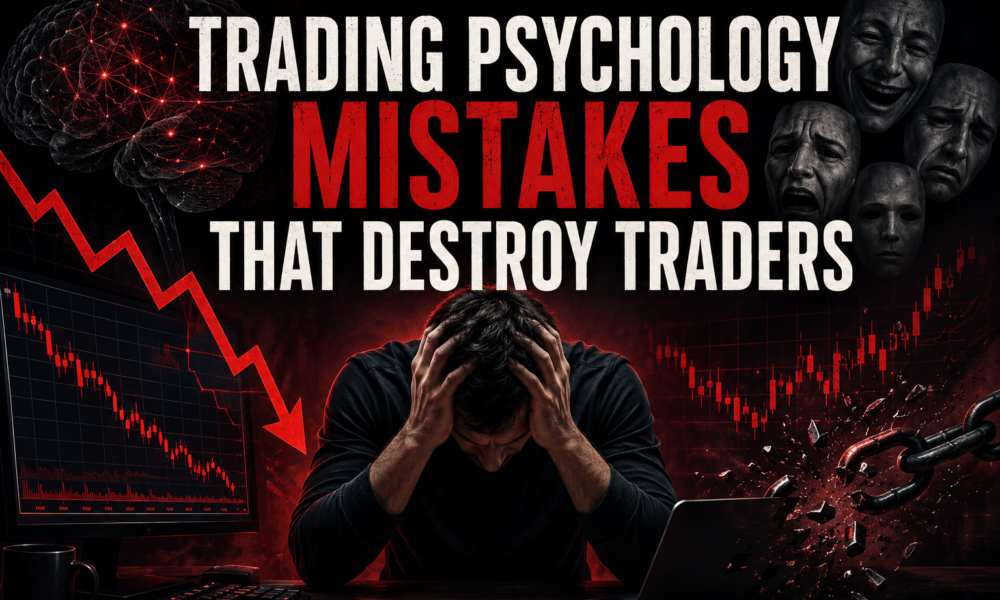
Every trader loses money at some point; that’s not the mistake. The real damage happens in the mind, long before a losing trade shows up on the screen. Trading psychology decides how you enter, how you exit, and whether you can sit still when the market tests your patience. Most traders blame strategy, indicators, or bad luck when things go wrong, but the truth is simpler and harder to accept: emotional trading is usually the real culprit.
Table Of Content
This article walks through five of the most common psychological mistakes that destroy traders, with real examples of how they play out and practical steps to fix each one. If you have ever entered a trade you regretted within minutes, this one’s for you.
Why Trading Psychology Matters More Than Strategy
Trading psychology quietly drives every entry, exit, and risk decision you make, even when you think you’re just following charts or indicators. When emotional trading takes over, a system that looks perfect on paper can still fail in real time because fear, greed, and impatience hijack your plan. The five patterns in this article are exactly the kind of psychological traps that destroy traders over months and years, not just in a single bad trade, which is why understanding them is as important as learning any new strategy.
1. FOMO: Chasing Trades
FOMO, the fear of missing out, is probably the fastest way to blow up a trading account. You watch a stock rally 8% in an hour, everyone on social media is celebrating, and suddenly you buy at the top just because you don’t want to miss the next leg up. Nine times out of ten, that’s exactly when the move runs out of steam, and you’re left holding the bag.
Say a trader buys a stock at ₹500 after it’s already up 12% for the day, chasing the momentum instead of waiting for a pullback. The stock reverses the next morning and drops to ₹460, a quick 8% loss on a trade that was never planned in the first place (example, illustrative figures).
This is where a disciplined trader mindset makes all the difference. Understanding how emotions affect trading decisions is the first step toward catching yourself before you click buy.
Before chasing a fast move, review your setup against your written rules and basic candlestick patterns from our candlestick guide.
Practical steps:
- Set entry rules in advance and only trade setups that meet them.
- Wait for a pullback or confirmation candle before entering a fast-moving stock. This is one of the simplest ways to avoid FOMO in trading.
Several broker education pages also list FOMO and overtrading among the top mental errors that hurt performance, such as Upstox’s article on trading psychology mistakes.upstox
2. Overconfidence After Wins
A few winning trades in a row can be dangerous. Confidence turns into overconfidence, position sizes creep up, and stop-losses start to feel optional. This is one of the common trading mistakes that quietly destroys accounts that were doing just fine a week earlier.
Picture a trader who turns ₹50,000 into ₹75,000 over three good trades. Feeling unstoppable, they double their position size on the next setup without adjusting risk. The trade goes against them, and a single bad day wipes out two weeks of gains (example, illustrative figures).
Overconfidence in trading rarely announces itself. It shows up as skipped research, ignored risk limits, and a quiet belief that you’ve somehow figured out the market. Strong trading psychology means treating every trade, win or lose, with the same discipline.
Practical steps:
• Keep position sizing fixed as a percentage of capital, regardless of recent results.
• Review your last five trades honestly before increasing size again. Overconfidence in trading often hides inside a winning streak.
3. Loss Aversion and Holding Losers
Loss aversion is the tendency to feel losses far more painfully than equivalent gains, and it’s one of the clearest examples of how traders lose money without even realizing it. Instead of cutting a losing position, traders hold on, hoping the price comes back, often turning a small loss into a large one.
Say a trader buys a stock at ₹1,000 with a mental stop at ₹950. The price drops to ₹950, but instead of exiting, they tell themselves it will bounce back. It doesn’t; the stock falls to ₹820, turning a planned 5% loss into a real 18% loss (example, illustrative figures).
Loss aversion in trading is rarely about the numbers; it’s about ego and hope overriding a plan. This is emotional trading at its most costly, and it’s a pattern worth studying closely if you want to protect your trading psychology over the long run.
Practical steps:
• Set a hard stop loss before entering the trade, not after.
• Accept small losses quickly; loss aversion in trading gets worse the longer a losing position sits open.
4. Confirmation Bias
Once a trader forms an opinion about a stock, they start noticing only the information that agrees with them. That’s confirmation bias, and it’s one of the common mistakes traders make with emotions running the show instead of evidence.
Imagine a trader convinced a company’s stock will rise because of a favorable news report. They ignore three separate signs of weakening sales and skip past analyst downgrades, focusing only on bullish comments in a trading forum (example, illustrative figures). The stock eventually falls 15% on disappointing quarterly results that had been visible for weeks.
Confirmation bias in trading feeds on selective attention. It’s part of a bigger pattern in stock market psychology, where traders build a story first and then hunt for facts that fit it, rather than the other way around. Solid trading psychology means actively looking for reasons you might be wrong.
Practical steps:
• Before entering a trade, list two reasons the trade could fail, not just why it could work.
• Follow at least one source that regularly disagrees with your view; confirmation bias in trading shrinks when you widen your information diet.
5. Herd Mentality and Recency Bias
Herd mentality in trading happens when traders follow the crowd into a stock simply because everyone else is buying, without checking whether the fundamentals support the move. Add recency bias, the assumption that whatever happened recently will keep happening, and you get traders piling into the same trade at exactly the wrong time.
A common example: a stock rallies for three straight weeks, financial news channels cover it daily, and new traders rush in near the top, assuming the trend simply continues. Two weeks later, the stock is down 20% as early buyers take profits (example, illustrative figures). This is a textbook case of how traders lose money by trusting the crowd over their own analysis.
Recency bias in trading convinces people that recent price action predicts the future, when markets are far messier than that. Herd mentality in trading and recency bias in trading often arrive together, reinforcing each other and weakening trading psychology at the worst possible moment. Understanding this pattern is part of basic stock market psychology.
Practical steps:
• Judge a trade on fundamentals and your own analysis, not on how crowded the trade already looks.
• Keep a trading journal to spot when recent wins or losses are quietly shaping your next decision.
Final thoughts
None of these patterns disappears overnight, but naming them is half the battle. Strong trading psychology isn’t about eliminating emotion; it’s about learning how to trade without emotions dictating your next click. Building a steadier trader mindset takes a written plan, honest reviews of your trades, and a real focus on how to control fear and greed in trading rather than pretending they don’t exist.
These common trading mistakes are also some of the clearest trading mistakes to avoid if you want your capital to survive long enough to compound. Subscribe for more practical trading psychology breakdowns, and grab our free risk-management checklist before your next trade.
For a structured overview of trading basics and mindset, you can also refer to IG’s trading for beginners guide.
FAQs
Q1: How to stop overtrading?
The fastest fix is a daily trade limit and a checklist before every entry. This is central to how to stop overtrading in the stock market and protects your trading psychology from decision fatigue late in the session.
Q2: Which bias costs traders the most?
Loss aversion tends to cause the most serious damage, since it turns small losses into account-threatening ones. It’s one of the common trading mistakes and remains among the hardest trading mistakes to avoid without a firm stop-loss rule.
Q3: How can I build more discipline as a trader?
Start by journaling every trade and reviewing it without judgment. A calmer trader mindset also comes from knowing how to avoid FOMO in trading and treating emotional trading as a signal to pause, not act.
Q4: What are the most common psychological mistakes that destroy traders?
They usually come down to five patterns: FOMO, overconfidence, loss aversion, confirmation bias, and herd behavior. Together, they form the psychological traps that destroy traders more often than any indicator or strategy ever could.
Q5: How do emotions affect trading decisions for someone just starting?
How emotions affect trading decisions is one of the first things beginners should study. Simple trading psychology tips for beginners, fixed position sizing, and written rules help build trading psychology that holds up under pressure.