



5 Things to Check Before IPO Investing: Lessons From Jio
Jio Platforms opens its initial public offering on 21 October 2026, and most Indians already have an opinion about it. A familiar brand makes you feel you know the company, but an IPO demands more...

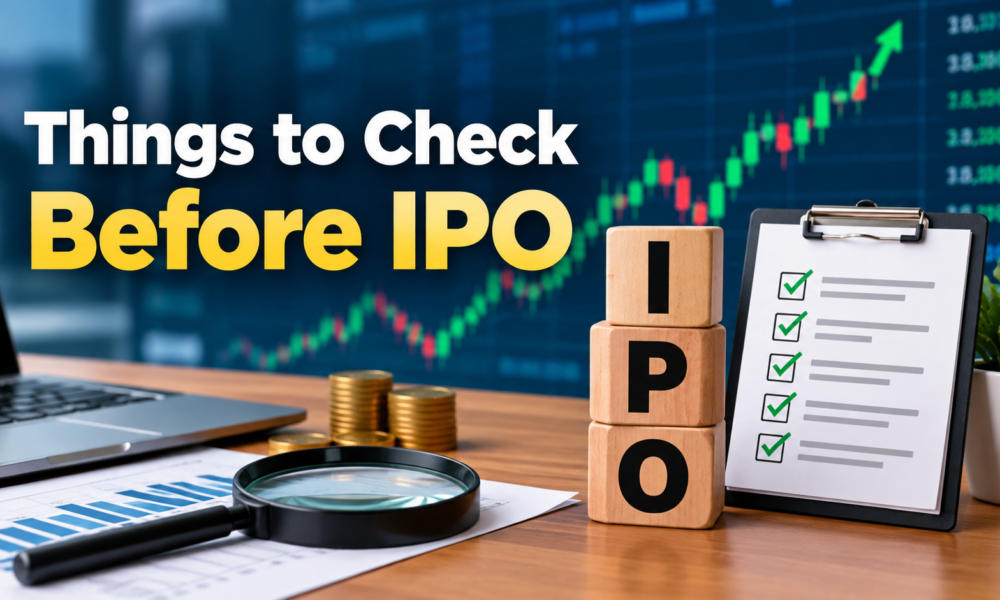
Jio Platforms opens its initial public offering on 21 October 2026, and most Indians already have an opinion about it. A familiar brand makes you feel you know the company, but an IPO demands more care. This guide covers the five things to check before IPO investing, using Jio’s offer documents as a live example.
Table Of Content
It will not tell you whether to apply, only how IPO investing for beginners can move from “everyone knows this brand” to “I understand what I am paying for.”
What Is an IPO and Why Does It Matter to Investors?
An IPO is the first time a company sells shares to the public. Once listed on the NSE and BSE, the shares trade like any other stock.
Companies go public to raise money, repay borrowings or let early shareholders exit. In a fresh issue, the company creates new shares and receives the money. In an offer for sale (OFS), existing shareholders sell and the company receives nothing.
Jio’s issue is entirely fresh, with no OFS. It offers up to 27 crore new shares, roughly 2.9% of post-issue equity, at a price band of ₹1,065 to ₹1,119. At the upper end, that is up to ₹30,213 crore. For IPO investing for beginners, this purpose is the first thing to understand.
5 Things to Check Before IPO Investing
The checklist below shows how to evaluate an IPO without leaning on tips.
| Factor | What to Check | Why It Matters | Jio Example |
|---|---|---|---|
| Business model | Revenue sources and customers | How the company earns | Mobile, broadband, digital services |
| Financial performance | Revenue, profit, cash flow | Financial strength | FY26 revenue ₹1,46,885 crore |
| Valuation | P/E ratio and peers | The price being asked | About 32 to 33 times FY26 earnings |
| IPO documents | RHP and use of proceeds | Disclosures and risks | Up to ₹27,500 crore for debt repayment |
| Growth and competition | Industry trends, rivals | Future challenges | Airtel, tariffs, spectrum dues |
1. Understand the Company’s Business Model
Ask who pays this company, and why they will keep paying. Jio Platforms is the holding company whose telecom arm is Reliance Jio Infocomm Limited (RJIL). Reliance Industries is the wider group parent.
Most revenue comes from mobile and home broadband subscribers. Jio reported 533.3 million customers on 30 June 2026. Earnings depend on average revenue per user (ARPU), the monthly revenue earned from each customer. Jio’s was ₹214 in the March 2026 quarter.
2. Check Revenue, Profit and Financial Performance
Look at three years, not one. Revenue growth shows here: revenue from operations rose from ₹1,09,558 crore in FY24 to ₹1,28,218 crore in FY25 and ₹1,46,885 crore in FY26. Profit after tax, the earnings left for shareholders, rose 15.1% to ₹30,049 crore in FY26.
Debt levels improved: net debt to EBITDA fell to 0.36 times from 0.71 times. Yet this is a capital-hungry business, with CARE Ratings noting capex of over ₹2 trillion on 5G, and market data sites report return on capital employed slipping to 10.76%. That is a mixed signal about company financial performance.
If you wonder how to analyse a company’s financials before an IPO, compare growth with the capital used to earn it. Good company financial performance shows up in cash flow and returns, not just headline profit.
3. Evaluate the IPO Valuation
Valuation is what you pay for each rupee of earnings. The price-to-earnings (P/E) ratio divides the share price by earnings per share (EPS). With FY26 basic EPS of ₹33.63, HDFC Sky calculates the price band at about 32 to 33 times earnings. SBI Securities puts it at 33.3 times, below Bharti Airtel’s 40.71 times.
That sounds cheaper, but the comparison has limits. Motilal Oswal estimates Jio at about 12 times projected FY28 EBITDA against 10.3 times for Airtel’s India business, so Jio looks cheaper on one yardstick and costlier on another. The filings state no valuation, so the reported ₹10.3 lakh crore market value is an estimate.
A strong business can still be expensive. This is how IPO valuation affects investors: the higher the multiple you pay, the more growth you need just to earn a fair return.
4. Read the RHP and Understand the Use of Funds
The Red Herring Prospectus (RHP) is the offer document issued before bidding opens, with bids placed within its price band as SEBI explains. It carries business details, audited financial statements, promoter information, the objects of the issue and the risk factors, the company’s own list of what could go wrong.
Reading it is the most skipped of the things to check before IPO investing. Here is what investors should check in an IPO prospectus: the objects of the issue, the risk factors, related party dealings and the notes to the financial statements.
For Jio, up to ₹27,500 crore is meant to repay or prepay certain RJIL borrowings, the rest to general corporate purposes. Lower debt cuts interest costs but adds no customers by itself.
5. Assess Competition, Growth Prospects and Investment Risks
Rivals Bharti Airtel and Vodafone Idea can limit how fast tariffs rise. Spectrum and licence rules sit outside the company’s control, and one broker’s reading of the draft prospectus points to over ₹1 lakh crore in deferred spectrum dues. These are the IPO investment risks behind the headline numbers.
Keep facts and expectations apart:
- Disclosed facts: the customer base, FY26 results and the debt repayment plan.
- Expectations: the RHP names fixed wireless broadband, enterprise connectivity, cloud and AI as growth areas, and Motilal Oswal expects EBITDA to grow about 15.2% a year from FY26 to FY29. No tariff hike is certain until announced.
Among the things to check before applying for an IPO, this needs the most time. The risks of investing in an IPO for beginners often come from mistaking forecasts for promises.
What Jio’s IPO Teaches First-Time Investors
Brand recognition shows a company is well known, not that the price is fair. Business fundamentals such as earnings, debt and returns settle that. Valuation matters even for strong companies: Jio is profitable, yet the multiple paid remains a fair question.
Listing gains are uncertain too. A grey market premium (GMP) is an unofficial signal that moves with market sentiment and says little about long-term value. Retail investors who apply only for a listing pop are betting on mood, not business.
The practical takeaway: treat the things to check before IPO investing as five questions you must answer in your own words. If you cannot explain the IPO investment risks in a sentence, do not bid yet.
Common IPO Investing Mistakes to Avoid
Most of these slips come from skipping the things to check before IPO investing.
- Applying only because a company is famous. Fame is not a metric.
- Expecting guaranteed listing gains. Listing day depends on demand and market conditions.
- Ignoring the IPO valuation. A great company bought at a stretched price can still disappoint.
- Skipping the RHP and risk disclosures. The company’s own warnings are free and often unread.
- Following buzz or grey market premium. It is unofficial and changes daily.
Conclusion
Jio’s IPO is a useful classroom because the documents are public and the debate is real. Knowing how to evaluate an IPO is about preparation, not prediction. Understand how the company earns, whether company financial performance holds beyond one year, what the price assumes and what could go wrong. Keep these things to check before IPO investing in front of you, and the decision belongs to you, not the crowd.